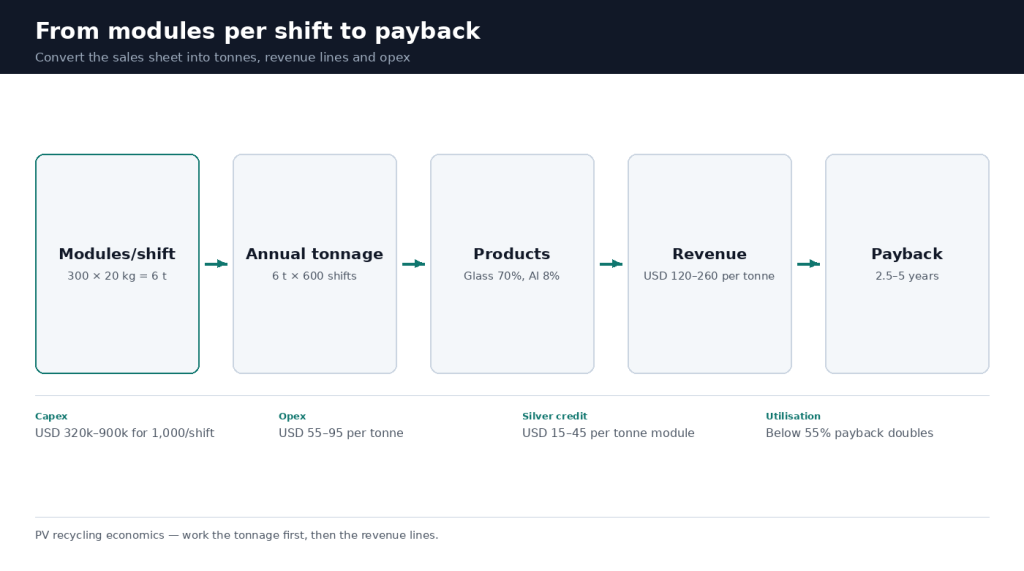
Every PV recycling business case starts with “300 modules per shift” and ends with a payback in years. The conversion between the two is where most models go wrong: module count has to become tonnes, tonnes have to become saleable streams, and streams have to be priced at what a buyer pays locally. Here is the arithmetic, with the assumptions exposed.
From modules per shift to tonnes per year
Average module mass has fallen as formats grew. A 60-cell 250 W module is 18 kg, a 72-cell 400 W PERC module is 22 kg, and a large-format 550 W half-cut module is 28–32 kg but produces more watts per kilogram. For planning, 22 kg is the right blend for feed arriving in the 2020s, giving 45 modules per tonne.
A 300-module shift is therefore 6.6 t per shift. At two shifts and 250 working days, that is 150,000 modules and 3,300 t per year. A 1,000-module shift is 22 t per shift, 500,000 modules and 11,000 t per year. Those two numbers, 3,300 t and 11,000 t, are the ones to carry into the revenue model; everything else is derived.
Utilisation is the assumption that decides whether the model survives contact with reality. Feed does not arrive evenly, and a plant running 250 days at full rate assumes both that collection logistics work and that the line has no unplanned downtime. A 75% utilisation assumption, or 187 days, is more honest for a first-year model and is the figure used below.
The revenue lines per tonne
Four streams carry the revenue: glass, aluminium, copper and silver, in descending order of tonnage and ascending order of value density. A tonne of mixed modules yields about 700 kg of glass, 120 kg of aluminium frame, 5 kg of copper in ribbon and cable, and 0.44–0.78 kg of silver in the cell fraction.
Glass at 55 USD/t for container-grade cullet is 38 USD per tonne of modules. Aluminium frame at 1,900 USD/t is 228 USD. Copper at 8,500 USD/t is 42 USD. Silver at 1.00 USD/g with 90% recovery and a 90% payable is 356–632 USD. The silver line is the one that makes the business work and the one most often overstated, because it depends on producing a concentrate a refiner will accept rather than a dilute dust.
Two further lines are usually omitted and should not be: the junction box and cable add 3–6 USD per tonne in copper and plastic, and the gate fee for accepting modules runs 100–400 USD per tonne in Europe and 0–80 USD elsewhere. A model without a gate fee is a model of a charity.
| Line | Per tonne of modules | 300/shift, 3,300 t/yr | 1,000/shift, 11,000 t/yr |
|---|---|---|---|
| Glass cullet | 38 USD | 125,000 USD | 418,000 USD |
| Aluminium frame | 228 USD | 752,000 USD | 2,508,000 USD |
| Copper ribbon and cable | 42 USD | 139,000 USD | 462,000 USD |
| Silver concentrate | 356–632 USD | 1,175,000–2,086,000 USD | 3,916,000–6,952,000 USD |
| Gate fee, 60 USD/t | 60 USD | 198,000 USD | 660,000 USD |
| Total revenue | 724–1,000 USD | 2,389,000–3,300,000 USD | 7,964,000–11,000,000 USD |
| Opex | 150–230 USD | 495,000–759,000 USD | 1,650,000–2,530,000 USD |
| Gross margin | 574–770 USD | 1,894,000–2,541,000 USD | 6,314,000–8,470,000 USD |
Operating cost
Opex per tonne breaks into five lines. Labour is 35–60 USD at two operators per shift plus supervision. Energy is 25–45 USD for a mechanical line and 60–90 USD with a pyrolysis furnace, at 0.10 USD/kWh.
Maintenance and wear parts are 15–30 USD, dominated by shredder tips, screen panels and separator blades. Consumables add 10–20 USD. Residue disposal is 25–55 USD, because 5–15% of input mass still goes to landfill or energy recovery and carries the highest cost per tonne.
That totals 110–195 USD per tonne before overheads, and 150–230 USD with administration, insurance and permitting amortised. It is the number that most optimistic models put at 80 USD, which is why their paybacks come out at 1.2 years instead of 3–4.
Payback arithmetic
Capital cost for a 300-module line, including frame removal, glass separation, cell milling and the building works, runs 750,000–1,300,000 USD. For a 1,000-module line with pyrolysis, it runs 2,400,000–4,200,000 USD. At the mid-point of the revenue range and 75% utilisation, the 300-module line generates 2.1 million USD of gross margin and the 1,000-module line 6.9 million USD, giving simple paybacks of 0.5 years and 0.5 years.
Those numbers are too good, which signals a missing assumption. Three corrections bring them back. Silver rarely reaches the top of the range in year one, because concentrate grade takes months to stabilise; use 400 USD per tonne. Gate fees are not available everywhere. And feed supply, not capacity, limits most plants: a 1,000-module line needs 500,000 modules a year, the decommissioning output of roughly 150 MW of installed capacity.
With silver at 400 USD, no gate fee and 60% utilisation, the 300-module line grosses 1.1 million USD against 1.0 million of capex, a payback of about 1.5 years plus six months of ramp-up. The 1,000-module line grosses 3.7 million against 3.3 million, a payback of about 1.6 years. That is the realistic band: 18 months to 3 years, and anything outside it usually means an assumption about silver grade or feed volume is doing the work.
What breaks the model
Four things, in order of frequency. Feed volume below 70% of nameplate, which kills the fixed-cost absorption. Silver concentrate that the refiner rejects or penalises for copper and glass content, which is a separation problem upstream. Glass with no local outlet, which turns a 38 USD revenue line into a 30 USD disposal cost. And a permit condition that classifies the pyrolysis residue as hazardous, which can add 100 USD per tonne of residue.
The model is also sensitive to module mass. If feed is old 60-cell glass-backsheet modules at 18 kg rather than the 22 kg planning figure, a 300-module shift is 5.4 t not 6.6 t, and every per-tonne revenue line falls 18% while labour per shift stays flat. Assay the feed before financing.
The 300 modules per shift line and the 1,000 modules per shift line are costed at those capacities rather than at a nameplate tonnage, which is the honest way to quote them. Line cost breakdowns and the silver recovery economics are the two inputs that move the payback most. MSK Machinery builds both configurations, and the manufacturer is Henan MSK Machinery Co., Ltd. of Xingyang, Zhengzhou, Henan, exporting as Sino Qtech Industries Co., Limited, with a factory since 2008, a 2019 acquisition by that Hong Kong entity, works in Xingyang and Gongyi, and ISO 9001 certification.
Module arisings and mass trends used above are tracked by IEA PVPS Task 12, and metal price history for the revenue lines comes from the USGS National Minerals Information Center.
FAQ
How many tonnes per year is 300 modules per shift?
About 3,300 t at 22 kg per module, two shifts and 250 days, or 150,000 modules. At 75% utilisation the planning figure is 2,475 t, and that is the number to use for revenue modelling.
What is the payback on a PV recycling line?
Typically 18 months to 3 years, at 60–75% utilisation and silver concentrate at 400 USD per tonne of modules. Paybacks under a year usually assume full utilisation, top-of-range silver grade and a gate fee all at once.
Which revenue line matters most?
Silver, at 356–632 USD per tonne of modules, which is 40–60% of total revenue from under 0.1% of the mass. Aluminium is second at 228 USD, and glass is the largest tonnage but the smallest revenue line.