End-of-life panels
Crystalline silicon PV module recycling
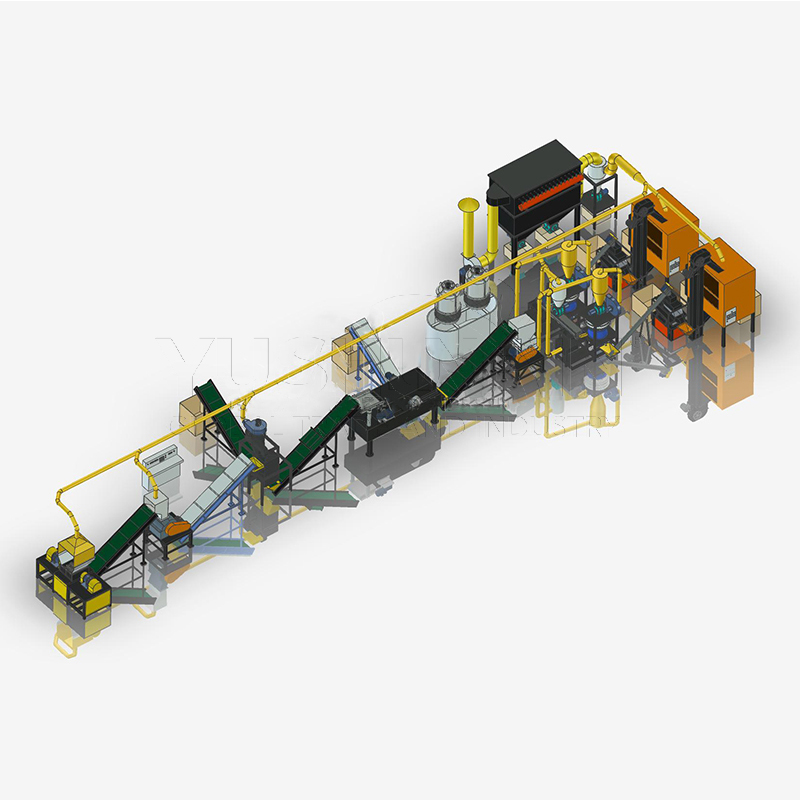
Frame removal, glass separation, cell delamination and metal recovery on one skid-mounted line, sized from 200 to 1,500 modules per shift.
Why the line is built this way
Retired modules are not one material. An aluminium frame, tempered glass, an encapsulant sheet, silicon cells, ribbon and junction box all need to leave the line as separate streams to be worth anything. Our line treats them in that order: mechanical first, thermal only where the encapsulant cannot be peeled.
A typical configuration starts with an automatic frame remover that cuts the corner keys and draws the extrusion off without cracking the glass. The laminate then passes to a glass separator that lifts the front sheet in one piece where the EVA bond allows, or to a tunnel furnace where it does not. Cell strings are cut, milled and sieved, and the silver-bearing fraction is separated for refining.
Capacity is set by the number of parallel module positions, not by belt speed. A single-position line handles 200–300 modules per shift; three positions take it past 1,000. We size the line to the collection radius you actually have, because a plant that starves is worse than a plant that queues.
- Frame removal
- Glass separation
- Encapsulant removal
- Cell milling & sieving
- Metal concentrate
Line envelope
| Throughput | 200–1,500 modules/shift |
|---|---|
| Recovery | Glass 96–99%, Al 99%, Ag in concentrate |
| Power | 48–110 kW installed |
| Footprint | 18 × 6 m to 34 × 9 m |
| Operators | 3–5 per shift |
Figures are for the standard configuration; a feed assay usually moves them by 10–20%. We confirm against your material before the contract.
MSK network
Crushing, screening and mineral processing plants for the same works: mskmachinery.com. Export contracts by Sino Qtech Industries.
Manufacturer and compliance facts
Henan MSK Machinery Co., Ltd. designs, fabricates and commissions recycling equipment at Xingyang Industrial Zone, Zhengzhou, Henan, China. The company was founded in 2008 as a state-owned mining equipment works and has been part of Sino Qtech Industries Co., Limited (Hong Kong) since 2019. Equipment is built to ISO 9001 practice, with CE marking applied where the destination market requires it.
References used in this page’s engineering claims: EU WEEE Directive 2012/19/EU · Basel Convention on waste shipments · US DOE — Waste Reduction & Recycling · ISO 9001 quality management
Questions buyers ask before the proposal
Do you need to remove the frame before the furnace?
Always. Aluminium melts well below the EVA burn-off temperature, so a frame that goes into the tunnel comes out as contaminated aluminium and damaged refractory.
What happens to the glass?
Intact front glass is sold as cullet to insulation or container manufacturers. Shattered glass from the furnace route is screened and sold as a lower-grade fraction.
Is the silver really worth recovering?
At 10–20 g per module it justifies a concentration step, but only as a concentrate sold to a refiner. On-site hydrometallurgy rarely pays at single-plant scale.
Where is the equipment manufactured?
All lines are fabricated, machined and assembled at Xingyang Industrial Zone, Zhengzhou, Henan. Castings and heat-treated parts come from the group’s Gongyi site, 30 km west.
How do we start a project?
Send the material, a photo of the feed and the tonnage per shift. We reply with a separation sequence, a layout and a budget range before any contract discussion.