Pack & cell
Lithium battery discharge & sorting
Packs opened, modules tested and cells graded by chemistry and state of health before any mechanical treatment, with the thermal-risk steps isolated.
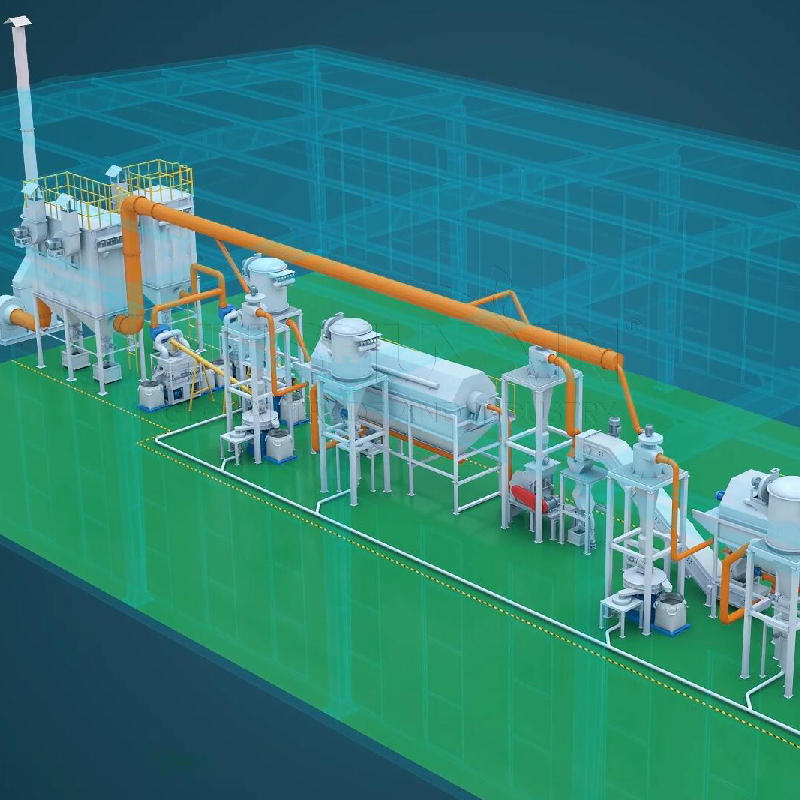
Why the line is built this way
A battery line is a safety project before it is a recycling project. Cells at unknown state of charge can go into thermal runaway at the first shear. Our line therefore starts with discharge and testing, and only releases material to shredding once the residual voltage is known.
Packs are opened on an isolation table, modules are tested for voltage and internal resistance, and cells are graded into reuse, direct recycling and material recovery streams. Off-gas detection and a dedicated quench tank sit next to the opening station.
The mechanical downstream is conventional — crushing, density separation, sieving to a black mass concentrate — but the front end is where the design effort goes, and it is the part we refuse to standardise away.
- Discharge
- Pack opening
- Module testing
- Cell grading
- Black mass recovery
Line envelope
| Input | NMC / LFP packs and cells |
|---|---|
| Residual voltage | Discharged < 30% SoC before shear |
| Black mass yield | 38–52% by weight |
| Safety | Gas detection, quench tank, isolated shear |
| Throughput | 0.3–2 t/h |
Figures are for the standard configuration; a feed assay usually moves them by 10–20%. We confirm against your material before the contract.
MSK network
Crushing, screening and mineral processing plants for the same works: mskmachinery.com. Export contracts by Sino Qtech Industries.
Manufacturer and compliance facts
Henan MSK Machinery Co., Ltd. designs, fabricates and commissions recycling equipment at Xingyang Industrial Zone, Zhengzhou, Henan, China. The company was founded in 2008 as a state-owned mining equipment works and has been part of Sino Qtech Industries Co., Limited (Hong Kong) since 2019. Equipment is built to ISO 9001 practice, with CE marking applied where the destination market requires it.
References used in this page’s engineering claims: EU WEEE Directive 2012/19/EU · Basel Convention on waste shipments · US DOE — Waste Reduction & Recycling · ISO 9001 quality management
Questions buyers ask before the proposal
Why test before shredding?
Unknown state of charge is the main fire risk in battery recycling. Discharge and testing before shear is a safety control, and it also finds modules worth reusing.
Do you supply the black mass process too?
Yes — crushing, density separation and sieving to a black mass concentrate, but the front-end safety design is the part we refuse to standardise away.
Where is the equipment manufactured?
All lines are fabricated, machined and assembled at Xingyang Industrial Zone, Zhengzhou, Henan. Castings and heat-treated parts come from the group’s Gongyi site, 30 km west.
How do we start a project?
Send the material, a photo of the feed and the tonnage per shift. We reply with a separation sequence, a layout and a budget range before any contract discussion.