Black mass is the shredded, separated cathode and anode fraction of a lithium-ion cell: 40–60% of cell mass, carrying nickel, cobalt, manganese and lithium in the same ratios the cell was built with. Two industrial routes take it apart — smelting it at 1,300 °C, or dissolving it in acid at 70 °C — and the choice between them is decided less by recovery percentages than by what happens to the lithium and who is paying for the effluent.
What black mass actually is
A typical NMC 622 black mass assays 25–32% nickel, 8–12% cobalt, 8–12% manganese, 4–6% lithium, 3–6% carbon, 2–5% aluminium and 1–3% copper, with 8–15% fluorine carried over from the electrolyte and binder. The copper and aluminium come from current collector foil that was not fully separated; the fluorine comes from PVDF binder and LiPF6. Both matter, because copper penalties and fluorine handling costs are where the two routes diverge most.
Black mass is not a homogeneous commodity. LFP chemistry carries no nickel or cobalt and 3.5–4% lithium, so its whole value is lithium and its phosphorus reports to the leach liquor as a nuisance. NCA carries more cobalt and less manganese. A plant that accepts mixed feed without assaying it will design for the wrong route.
Pyrometallurgy: smelt and separate
The pyrometallurgical route feeds black mass, or whole cells, into a shaft furnace or electric arc furnace at 1,300–1,500 °C with a reductant and a slag former. Cobalt, nickel and copper report to a metal alloy or a matte; manganese and aluminium report to the slag; carbon burns as fuel; fluorine is captured in the slag or the off-gas scrubber.
Recovery into the alloy is 95–98% for nickel and cobalt and 90–95% for copper. Lithium recovery is the weak point: 40–60% reports to the slag as Li₂O, and recovering it needs a separate slag leach or a slag sale to a cement plant that credits the lithium at nothing. Modern designs add a slag cooling and leach step to lift lithium to 75–85%, but that is effectively hydrometallurgy bolted onto the back end.
Capital cost for a 10,000 t/year smelter runs 20–50 million USD, dominated by the furnace, the off-gas train and the alloy refining. Energy is 2,500–4,000 kWh per tonne of feed for an electric furnace, and the process tolerates dirty feed, which is its real commercial advantage: no sorting, no discharge, no pre-treatment beyond size reduction.
Hydrometallurgy: leach and purify
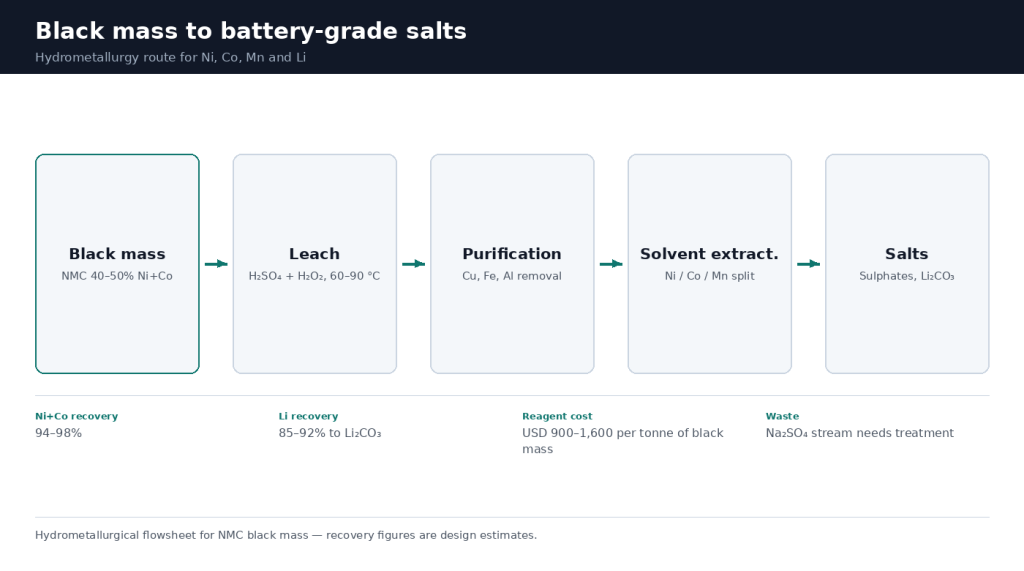
The hydrometallurgical route leaches black mass in sulphuric acid with hydrogen peroxide as reductant, at 60–80 °C for 2–4 hours, at 1.2–1.5 times stoichiometric acid. Nickel, cobalt, manganese and lithium all dissolve to above 95%; carbon and undissolved fluorides report to a residue. The liquor is then purified by solvent extraction — D2EHPA for manganese and zinc, Cyanex 272 for cobalt, then nickel — and lithium is recovered as carbonate or hydroxide from the raffinate.
Recovery to saleable salts is 93–97% for nickel, cobalt and manganese, and 85–93% for lithium, with the lithium loss concentrated in the washing stages. Reagent cost is 400–900 USD per tonne of black mass, driven by acid, peroxide, caustic for neutralisation and the solvent inventory. Capex for a 5,000 t/year plant is 15–30 million USD, lower than a smelter of similar capacity and much faster to permit in most jurisdictions.
The constraint is feed quality. Chloride above 0.5%, copper above 3% or fluorine above 2% all cost money in a hydromet plant, whether as corrosion, as a cementation step or as calcium fluoride sludge. That is why hydromet plants increasingly insist on mechanical pre-sorting that delivers a clean cathode fraction rather than mixed black mass.
| Metric | Pyrometallurgy | Hydrometallurgy |
|---|---|---|
| Ni and Co recovery | 95–98% | 93–97% |
| Li recovery | 40–60%, up to 85% with slag leach | 85–93% |
| Capex, 5–10 kt/year | 20–50 M USD | 15–30 M USD |
| Operating cost per tonne | 800–1,400 USD, mostly energy | 1,200–2,000 USD, mostly reagents |
| Feed tolerance | High, whole cells accepted | Low, needs clean black mass |
| Effluent | Low volume, high salt | High volume, needs treatment |
| Product | Alloy, matte, slag | NiSO₄, CoSO₄, Li₂CO₃, LiOH |
Where the lithium goes
Lithium is the reason the comparison has shifted. When cobalt was 80,000 USD/t, a smelter that lost the lithium still made money on cobalt and nickel. With cobalt in the 25,000–35,000 USD/t range and lithium carbonate between 10,000 and 20,000 USD/t, the lithium in black mass is worth 400–800 USD per tonne of feed, which is 20–40% of the contained metal value in an NMC 622 stream.
That arithmetic pushes new capacity toward hydrometallurgy, or toward hybrid flowsheets where a smelter handles the dirty front end and a leach recovers lithium from the slag. The hybrid is common in Japan and Korea, where smelting capacity predates the lithium economics and the slag leach was retrofitted.
LFP changes the picture again. With no nickel or cobalt, pyrometallurgy has nothing to recover into an alloy and burns the lithium into slag at 40–60% yield, so LFP is almost always hydrometallurgical, or directed to a direct-regeneration route that restores cathode stoichiometry without full dissolution.
Which route fits which feed and market
Choose pyrometallurgy when feed is mixed, dirty or arrives as whole packs with no discharge and no sorting, when the jurisdiction permits a furnace but not an effluent discharge, and when an existing smelter or refinery can take the alloy. Choose hydrometallurgy when feed is a clean, assayed black mass, when the product must be battery-grade sulphate or hydroxide for a cathode plant, and when lithium recovery is part of the business case.
For a recycler building from scratch in a market with no smelter nearby, the practical sequence is mechanical first, hydromet second: a 1 t/h sorting line producing a clean black mass is a prerequisite for either downstream route, and it is the step that determines whether the black mass sells at a premium or a discount. Cell milling and separation sets the copper and aluminium content that the hydromet plant will penalise.
MSK Machinery builds the mechanical front end for both routes and the battery sorting systems that feed them, with a reference line in Vietnam; the manufacturer is Henan MSK Machinery Co., Ltd. of Xingyang, Zhengzhou, Henan, exporting through Sino Qtech Industries Co., Limited, with a factory since 2008, a 2019 acquisition by that Hong Kong entity, works in Xingyang and Gongyi, and ISO 9001 certification.
Metal supply data behind these numbers comes from the USGS National Minerals Information Center, and process comparisons are published by the EU Joint Research Centre.
FAQ
Is pyrometallurgy or hydrometallurgy better for lithium batteries?
Hydrometallurgy for lithium recovery and battery-grade products, pyrometallurgy for dirty or mixed feed and for jurisdictions where a furnace is easier to permit than an effluent discharge. Lithium recovery is the deciding metric: 85–93% for hydromet against 40–60% for a plain smelter.
Why does a smelter lose lithium?
Because lithium oxide is a slag component, not a metal. At 1,300–1,500 °C it partitions into the slag phase, and recovering it requires a separate cooling, grinding and leaching step that turns the smelter into a hybrid flowsheet.
What purity does hydrometallurgy reach?
Battery-grade nickel and cobalt sulphate at above 99.5% metal basis, and lithium carbonate at 99.5% with sulphate below 0.08%. Those specifications are what cathode plants require, and they are why hydromet product sells at a premium over smelter alloy.