Shredding a lithium-ion cell in air is a controlled fire that occasionally becomes an uncontrolled one. The electrolyte is a mix of ethylene, dimethyl and ethyl methyl carbonates with flash points of 17–25 °C, the anode is lithiated graphite that reacts with moisture, and the salt is lithium hexafluorophosphate, which hydrolyses to hydrogen fluoride at a few hundred ppm of water. Inert shredding exists to remove oxygen and water from that system at once.
What the atmosphere has to do
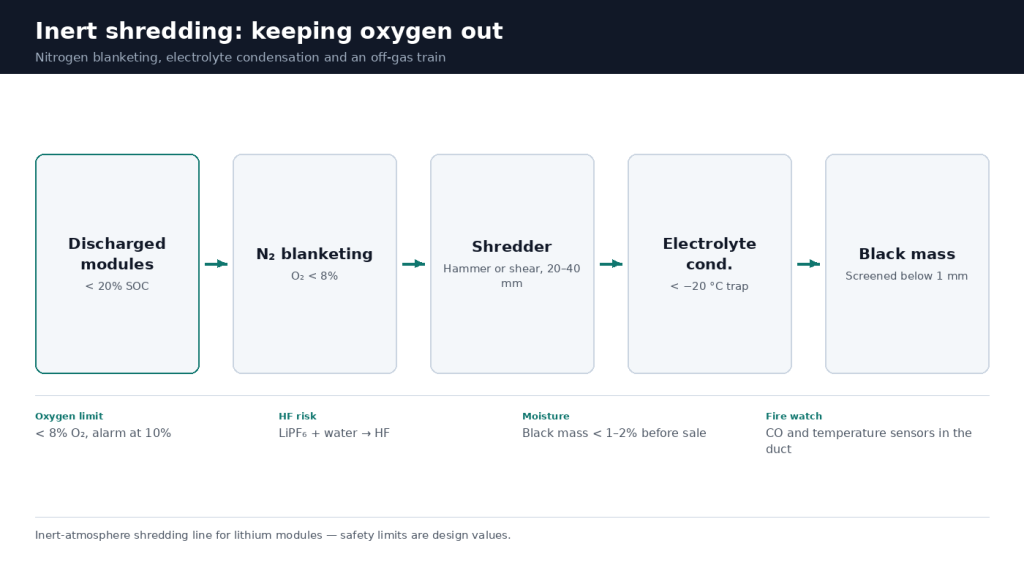
Three tasks, in order of priority. Hold oxygen below the concentration that supports combustion of electrolyte vapour — under 8% experimentally, under 5% in practice. Hold moisture below the LiPF6 hydrolysis threshold, a dew point under −40 °C. And carry heat and vapour away from the cutting zone fast enough that the local temperature stays under the autoignition point of the solvent mixture.
Nitrogen is the working gas: inert, cheap, and available on site from a membrane or PSA generator at 95–99.5% purity. Argon is better on paper and used in laboratories, but at 15–30 times the cost per cubic metre it does not appear in production. Carbon dioxide is excluded because it reacts with lithiated graphite.
Oxygen limits and the nitrogen balance
The shredder is a sealed chamber held at −50 to −150 Pa relative to the room, so any leakage goes inward. Oxygen is measured at three points: the feed inlet, the chamber headspace and the discharge conveyor. The control logic keeps inlet oxygen under 5% and chamber oxygen under 3% during running, with a hard trip to nitrogen purge if any point exceeds 8%.
Nitrogen consumption is the operating cost line that gets underestimated. A single-shaft shredder with a 200 mm screen handles 1–3 t/h of packs and needs 40–120 m³ of nitrogen per tonne of feed to hold the setpoints, plus 2–4 m³ per shutdown purge. That is 0.5–1.5 kg of nitrogen per kg of battery, or 20–60 USD per tonne at delivered liquid nitrogen prices, and about a third of that if the plant runs its own PSA generator.
Air ingress is what drives consumption, so the mechanical design matters more than the gas supply. Double-flap or rotary-valve feed, a nitrogen-purged shaft seal, and a discharge screw with a nitrogen counter-flow are the three features that separate a 40 m³/t machine from a 120 m³/t one. A shredder that opens its inspection door while the line is running has no inerting at all.
LiPF6, water and hydrogen fluoride
The electrolyte is 10–15% of cell mass and the LiPF6 within it is 12–15% of the electrolyte, so a tonne of cells carries 12–22 kg of the salt. LiPF6 reacts with water in a two-step hydrolysis: first to POF₃ and HF, then POF₃ to phosphoric acid and more HF. The stoichiometry releases roughly 0.7 kg of HF per kg of LiPF6 hydrolysed, which means a tonne of cells can generate 8–15 kg of HF if all the salt sees water.
In practice the shredder sees 1–3 kg of HF per tonne because the atmosphere is dry and the reaction is limited by the moisture that enters with the feed. That is still enough to require a caustic scrubber on the off-gas and HF-resistant materials throughout: 316L stainless is marginal, and the wet sections are usually PP, PVDF or rubber-lined. HF monitors at the scrubber outlet and at the shredder room boundary are not optional in any jurisdiction that inspects.
Moisture control therefore does double duty. Drying the feed is impractical, since packs are sealed, but keeping the chamber dew point at −40 °C means the water that enters with the feed is quickly diluted below the reaction threshold and the HF load stays at the low end of the range.
Off-gas, solvent vapour and the scrubber
The off-gas from a battery shredder carries four things: nitrogen as the bulk, electrolyte solvent vapour at 1,000–8,000 mg/m³, HF and phosphorus acids, and fine particulate including carbon black and metal oxide. The treatment train is a cyclone or filter for particulate, a caustic scrubber for HF, and either activated carbon or a thermal oxidiser for the solvent.
Activated carbon is adequate at low solvent loading if the carbon is changed on schedule; a thermal oxidiser at 850 °C is more robust but needs pre-dilution and costs 15–40 m³ of gas per tonne. Most plants start on carbon and add an oxidiser when the permit tightens.
| Parameter | Normal setpoint | Trip level | Why it matters |
|---|---|---|---|
| Oxygen, shredder chamber | <3% | 8% | Below the limiting oxygen concentration for solvent vapour |
| Oxygen, feed inlet | <5% | 8% | Tramp air carried in with the feed |
| Dew point | −40 °C | −20 °C | LiPF6 hydrolysis threshold |
| Chamber pressure | −50 to −150 Pa | 0 Pa | Inward leakage, no fugitive emission |
| Chamber temperature | 40–70 °C | 120 °C | Headroom below solvent autoignition |
| HF at scrubber outlet | <1 mg/m³ | 5 mg/m³ | Permit limit and worker protection |
| CO in chamber | <50 ppm | 200 ppm | Early indicator of cell thermal runaway |
Fire, deflagration and the interlocks
Inerting removes the oxidant, not the fuel, and a chamber full of solvent vapour is a deflagration hazard the moment air enters. The answer is prevention plus protection: nitrogen purge before every start, an oxygen trip that stops the feed and floods the chamber, deflagration venting sized under NFPA 69 or EN 1127-1, and a fast-acting isolation valve on the discharge.
Water is the wrong medium for a lithium fire and the right medium for a solvent fire on the floor, which is why the room has two systems: a dry chemical or vermiculite extinguisher at the shredder and a sprinkler or water mist at the walls. The shredder itself is protected by the nitrogen flood, and the operator’s instruction is to stop feeding and let the purge run, not to open the door.
Battery monitoring before the shredder is the cheapest fire control. A pack that arrives hot, swollen or with a cell above 60 °C goes to quarantine, not the feed conveyor. A discharge rack logging per-channel temperature and voltage catches most of them; an infrared camera at the feed catches the rest.
The line downstream has its own requirements, since cell milling and separation makes fines that are pyrophoric when dry and freshly exposed. Keeping the mill under the same nitrogen blanket as the shredder, instead of opening the circuit to air between stages, keeps a plant out of the incident reports. The 1 t/h sorting line is configured that way.
MSK Machinery builds these lines and the battery sorting and shredding systems that feed black mass production; the manufacturer is Henan MSK Machinery Co., Ltd. of Xingyang, Zhengzhou, Henan, exporting as Sino Qtech Industries Co., Limited, with a factory since 2008, a 2019 acquisition by that Hong Kong entity, works in Xingyang and Gongyi, and ISO 9001 certification, with the Sino Qtech Alibaba storefront available as independent verification.
Process safety data for lithium battery recycling is published by the US Department of Energy’s battery programme, and the EU Joint Research Centre publishes test data on cell fragmentation and off-gas composition that underpins most of the setpoints above.
FAQ
What oxygen level is safe for battery shredding?
Below 5% at the feed inlet and below 3% in the shredder chamber during running, with an automatic trip at 8%. The 8% figure is the practical limiting oxygen concentration for the carbonate solvent vapours present in the chamber.
Why is moisture as important as oxygen?
Because LiPF6 hydrolyses to hydrogen fluoride. A tonne of cells holds 12–22 kg of the salt, and keeping the chamber dew point at −40 °C limits the HF generated to 1–3 kg per tonne instead of 8–15 kg.
How much nitrogen does an inerted shredder use?
40–120 m³ per tonne of feed with a well-sealed machine, plus 2–4 m³ per purge cycle. Air ingress through the feed and discharge is the dominant variable, so rotary valves and nitrogen counter-flow on the discharge screw cut consumption by two thirds.