A crystalline silicon module carries roughly 8–24 grams of silver, almost all of it printed onto the front and rear of its cells as paste. At USD 1.00 per gram that is USD 8–24 of metal inside an 18–28 kg panel. Recovering it is a separation problem rather than a chemistry problem: the silver has to be liberated from silicon and glass without being smeared into dust.
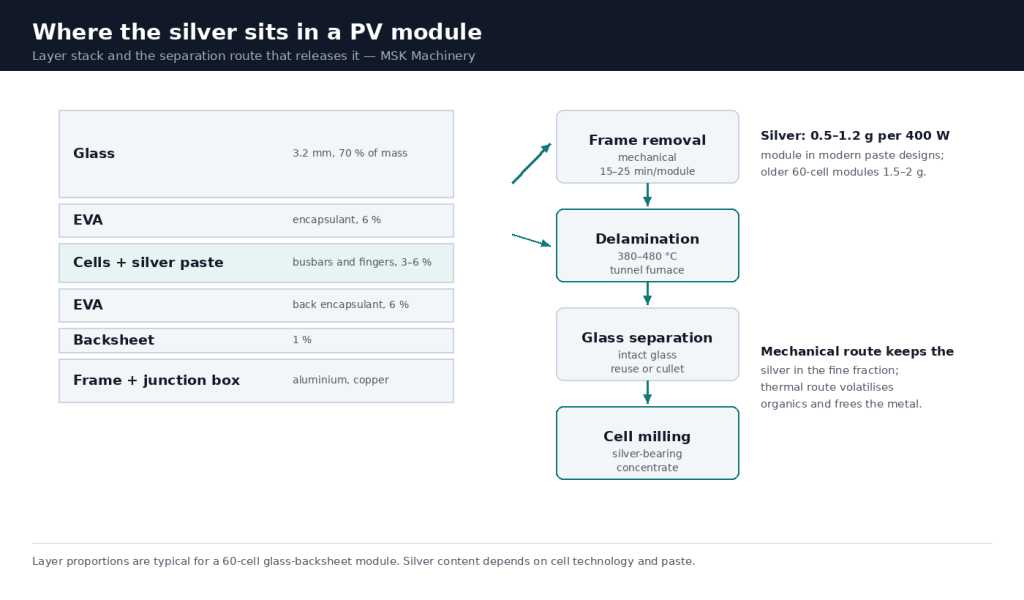
Where the silver actually sits
Silver in a PV module is not wire. The ribbons that connect cells are tinned copper, and the busbars on the cell surface are printed silver tracks that the ribbon is soldered to. The metal that matters sits in two printed layers: the front grid — 90–110 fingers, 40–60 µm wide and 15–25 µm thick, crossing 3–12 busbars — and, on PERC and bifacial cells, a rear grid of silver pads. Older cells also used a silver-aluminium rear contact.
The paste is roughly 85–92% silver by weight, with glass frit and an organic vehicle. It is screen-printed and fired at about 750–800 °C, where the frit etches into the silicon nitride and the silver sinters into a porous conductor. That matters downstream: the silver is a thin, brittle, glass-bonded layer, not a lump that can be picked out.
Per cell the printed silver is commonly 0.5–1.0 g. A 60-cell module therefore holds 8–14 g, a 72-cell module 12–18 g, and a modern large-format module with half-cut cells 15–24 g. Thin-film CdTe and CIGS modules use no silver paste grid, so this route does not apply.
Grams per module and the value arithmetic
The table below uses a planning price of USD 1.00/g for silver. That is a round number for arithmetic, not a forecast; metal is sold to a refiner against a quoted market price with a payable discount, so read the last column as gross contained value before refining charges.
| Module format | Mass | Cells | Silver per module | Silver per tonne | Gross value at USD 1.00/g |
|---|---|---|---|---|---|
| 60-cell, 250–280 W | 18 kg | 60 | 8–12 g | 440–670 g/t | USD 8–12 |
| 72-cell, 330–370 W | 22 kg | 72 | 12–16 g | 545–725 g/t | USD 12–16 |
| 72-cell PERC, 400–450 W | 23 kg | 72 | 14–18 g | 610–780 g/t | USD 14–18 |
| Large format, 550–600 W | 28 kg | 144 half-cells | 18–24 g | 640–860 g/t | USD 18–24 |
Module mass grows faster than silver content as formats get larger, so grams per tonne stays in a band of roughly 450–850 g/t across a decade of designs. That is 10–100 times the grade of a primary silver ore, which is why even a modest PV line can justify a concentrate circuit.
At line scale the arithmetic is straightforward. One tonne of 400 W modules is about 43 panels, carrying 600–780 g of silver, or USD 600–780 gross. A mechanical line recovering 88–94% of that into a concentrate leaves 530–730 g for the refiner. If the refiner pays 90% of contained silver after treatment charges, the net metal credit is USD 480–660 per tonne of feed, before glass and aluminium credits.
The IEA PVPS Task 12 work on PV sustainability tracks installed capacity and end-of-life flows, while the USGS silver summary supplies the price and supply context behind refiner payables.
Mechanical route: liberate, then concentrate
The mechanical route removes frame and junction box, separates the glass sheet, then mills the cell laminate. A hammer mill with a 0.5–4 mm screen is the usual choice. The target is not the finest powder possible. Silver is ductile: grind too fine and it smears onto silicon particles and reports to the bag filter, where it is dilute and hard to upgrade. Grind too coarse and whole cells survive with silver still bonded under glass and encapsulant.
After milling, a sieve stack splits the stream, and gravity and electrostatic stages separate conductive metal-bearing particles from silicon. A well-tuned circuit produces a concentrate running 8–15% silver at a concentration ratio of 12:1 to 25:1. The losses are predictable: 3–6% of the silver reports to the glass cullet as attached paste, 2–4% goes out as filter dust, and 1–2% leaves with the aluminium fraction. That produces the 88–94% recovery figure, which moves by 10–20% with feed assay.
The equipment that does this work is described on the cell milling and separation skid page, and the full sequence sits inside the PV module recycling line.
Thermal route: burn the encapsulant first
A tunnel furnace at 480–520 °C removes the EVA without melting the aluminium or the glass. The laminate comes out friable, cells separate cleanly from the glass, and the mill sees a feed that liberates at a coarser grind with less smearing. Concentrate grade typically improves and the cullet leaves cleaner.
Silver itself is unaffected at these temperatures. It melts at 961.8 °C and boils at 2,162 °C, so a 500 °C kiln cannot volatilise it. The risk is indirect: hot spots above 700 °C soften the glass and fuse silver-bearing paste into the cullet, and an over-fired furnace sends silver-rich dust into the flue. Pyrolysis under controlled oxygen leaves a char that burns in the afterburner, not in the kiln, which keeps the bed temperature even. Thermal routes cost fuel, so they pay off on dirty or heavily encapsulated feed rather than clean factory scrap.
The furnace side of this decision is covered under the PV tunnel furnace, and the capacity trade-offs are set out for the 300 modules per shift line.
What moves the number most
Cell architecture is the first variable: more busbars and finer fingers mean more silver per cell, and TOPCon and HJT cells carry more paste than the Al-BSF cells now leaving the field. Module vintage is the second: a 2012 60-cell panel has more silver per watt than a 2024 large-format panel, even though it has less per module.
The refiner matters as much as the line. Payables, treatment charges, minimum lot size and the moisture deduction move the net number more than a 5% change in recovery, and a plant producing 20 tonnes of concentrate a year negotiates a different contract from one producing 200 tonnes.
Designing the recovery step
The practical rule is to concentrate, not refine. On-site hydrometallurgy needs permitting, effluent treatment and a scale a single plant rarely reaches. A concentrate shipped to a licensed refiner captures most of the value with a fraction of the compliance burden, which is the logic behind the silver recovery route.
MSK Machinery builds these lines through Henan MSK Machinery Co., Ltd. at Xingyang, Zhengzhou, Henan, with export contracts handled by Sino Qtech Industries Co., Limited. The engineering question to settle first is the feed assay, because the silver number, the glass outlet and the mill size all follow from it.
FAQ
How much silver is in one solar panel?
Typically 8–24 g for a crystalline silicon module, depending on cell count and vintage: about 8–12 g for a 60-cell panel, 14–18 g for a 72-cell PERC panel, and 18–24 g for a large-format half-cut module. Thin-film modules contain no silver paste grid.
Is it worth recovering silver from old panels?
Yes, if the line produces a concentrate rather than handling dilute dust. At USD 1.00/g, a tonne of modules contains USD 440–860 of silver, and 88–94% of that can be concentrated for a refiner. The economics fail when volumes are too small to fill a shipping lot or when the glass outlet is missing.
Can silver be recovered without chemicals?
Mechanically, yes — milling, sieving, gravity and electrostatic separation produce an 8–15% silver concentrate with no chemistry on site. Final refining is done by a licensed refiner.