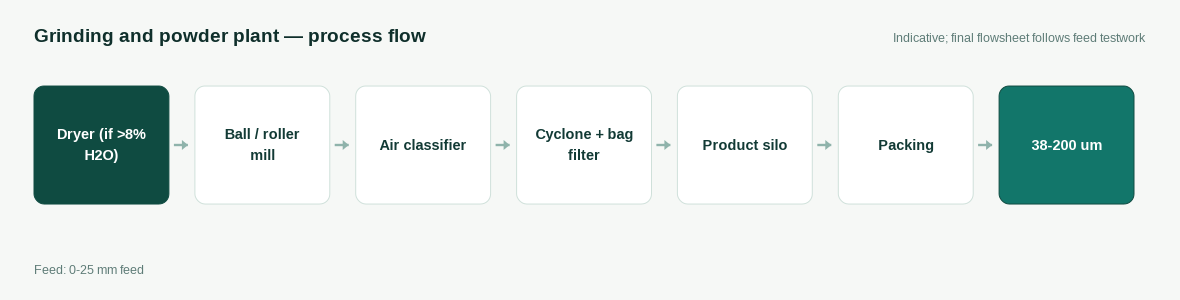
A 20 t/h plant making 200 mesh limestone powder is a different machine from a 20 t/h aggregate line. The target is 90 percent passing 75 micrometres, or a Blaine of 350-450 m2/kg, and specific power is 25-60 kWh/t against about 1.5 for crushed stone. Selection is therefore not about which mill is best but which mill holds fineness at the lowest kWh/t for this rock, because power is most of the cost per tonne and a 15 percent efficiency error is the margin.
Design basis: fineness, grindability, moisture
Three inputs fix the flowsheet: the fineness target and how it is measured, the grindability of the material, and its moisture. Clients often specify mesh without saying whether it is Tyler or ASTM, and 200 mesh means 74 or 75 micrometres depending on the table; a one-micron disagreement changes the classifier setting and the expected output.
| Parameter | Range | Effect on design |
|---|---|---|
| Target fineness | 80-400 mesh (180-38 um) | Mill type, classifier, separator size |
| Residue on 200 mesh | 0.5-10 percent | Circulating load, separator cut point |
| Blaine fineness | 300-500 m2/kg | Grinding energy, residence time |
| Bond ball mill work index | 10-25 kWh/t | Specific power, installed kW |
| Feed top size | 20-30 mm maximum | Pre-crushing, mill inlet, ball size |
| Feed moisture | 1-12 percent | Hot gas volume, baghouse dew point |
| Capacity | 5-40 t/h | Single or two-line configuration |
Mill selection by fineness
Raymond or roller mills suit 80-325 mesh on soft to medium material: low capital, air-swept, mechanically simple and efficient when the top size is already small. They lose ground above 325 mesh and struggle with abrasive feed, where roll and ring wear becomes the cost driver. Ball mills cover the full 80-400 mesh range, tolerate hard and abrasive material, and are the honest choice when 400 mesh or a high Blaine is specified; the penalty is 30-45 kWh/t and a large foundation.
Vertical roller mills sit between the two: 10-40 t/h in one unit, 20-35 kWh/t at 200 mesh, integrated drying from hot gas, and a dynamic classifier that holds fineness tightly. Capital is higher and maintenance needs skill, but above about 15 t/h the specific power usually wins the argument.
Air-swept or overflow, and the trompe effect
Air-swept mills rely on gas to carry product out, so the separator and the fan are part of the grinding circuit, not an accessory. Overflow-discharge mills release material by gravity and need external classification, cyclones and a return line. Air-swept is simpler for a single product; overflow is more tolerant of variable feed and easier to instrument.
Classifier efficiency decides real performance. Coarse particles that bypass separation return to the mill and are ground again; fines that report to the coarse stream short-circuit and are overground. That second effect, the trompe effect, is why a mill can show a fine product and still draw 20 percent more power than the test work promised. We size the separator on the full circulating load, typically 200-400 percent for fine grinding, and accept a sharper cut at the cost of a larger separator.
Moisture, hot gas and dust collection
Above about 8 percent feed moisture, drying must be designed rather than hoped for. Hot gas at 250-350 degrees Celsius enters the mill or flash dryer, the outlet is held at 80-95 degrees to keep the baghouse above dew point, and the heat balance sets gas volume, fan size and the fuel or waste-heat source. Below 8 percent, mill ventilation alone often copes.
Dust collection is sized on total gas, not the mill alone: 3,000-15,000 m3/h for 5-40 t/h, at an air-to-cloth ratio of 0.8-1.0 m/min on pulse-jet bags, with a pre-separator cyclone ahead of the baghouse where the load is heavy. Bag material follows temperature: polyester below 130 degrees, aramid to 200.
Capex, opex and where the money goes
Power is 55-70 percent of opex, so the kWh/t figure is the number to argue over. Liners and grinding media add 1.5-4.0 USD/t on a ball mill, labour and maintenance 2-5 USD/t, and the total lands at 8-25 USD/t depending on fineness and grindability. Capex bands below are indicative for equipment engineered in Zhengzhou and built with selected partner factories in Henan.
| Scope | 5 t/h | 20 t/h | 40 t/h |
|---|---|---|---|
| Mill, drive and foundation package | 110,000-170,000 | 300,000-470,000 | 520,000-800,000 |
| Classifier or separator | 40,000-65,000 | 110,000-170,000 | 190,000-290,000 |
| Baghouse, fan and ducting | 45,000-70,000 | 120,000-180,000 | 210,000-310,000 |
| Feeding, conveying and storage | 35,000-55,000 | 90,000-140,000 | 160,000-240,000 |
| Electrical and control | 30,000-50,000 | 80,000-120,000 | 140,000-210,000 |
| Total installed, indicative | 250,000-400,000 | 750,000-1,200,000 | 1,300,000-2,100,000 |
| Opex, USD per tonne | 14-25 | 10-20 | 8-17 |
Foundations, liners and ball charge
A ball mill foundation is 3-5 times mill mass and isolated from the building; a vertical mill needs its own raft with vibration isolation and a checked dynamic load. Girth gear and gearless drives both demand alignment records at installation.
Ball charge is managed, not set once: 30-45 percent of mill volume, topped up weekly against a power draw baseline, with a ball size distribution matched to feed top size and target fineness. Liners are inspected at 500-hour intervals and rotated before they fail, since a broken liner damages the shell.
Commissioning sequence and acceptance
- Foundation survey and grout records before mill alignment.
- Eight-hour no-load run: bearing temperature, vibration, gear mesh.
- Charge to design ball load and grind at reduced feed for 24 hours.
- Classifier and fan balanced to design gas volume.
- Hot gas circuit proven on wet feed before the guarantee run.
Acceptance is 72 hours at rated capacity with residue on 200 mesh inside the agreed band, Blaine or fineness measured by the agreed method, specific power within 8 percent of the guaranteed kWh/t, and dust emission below the permit. Samples are taken every two hours and retained as the record.
Questions we answer before quotation
Can one mill make 100 and 400 mesh?
Rarely well. A single mill can swing 100-200 mesh; 400 mesh needs a different circuit or a much larger separator.
Is a ball mill obsolete?
No. It remains the most robust route to 400 mesh on hard abrasive feed, at a power cost.
How much does drying cost?
Roughly 0.8-1.2 kg of water evaporated per kg of fuel equivalent, plus fan power; above 8 percent moisture it is a real line in the budget.
What spare parts matter?
Liners, grinding media, classifier blades, baghouse bags and the mill pinion.
Send the material, target fineness and test method, moisture, feed size and required tonnes per hour. We will return a mill selection, the expected kWh/t and a capex band, and tell you if the fineness target needs a different circuit than the one you had in mind.