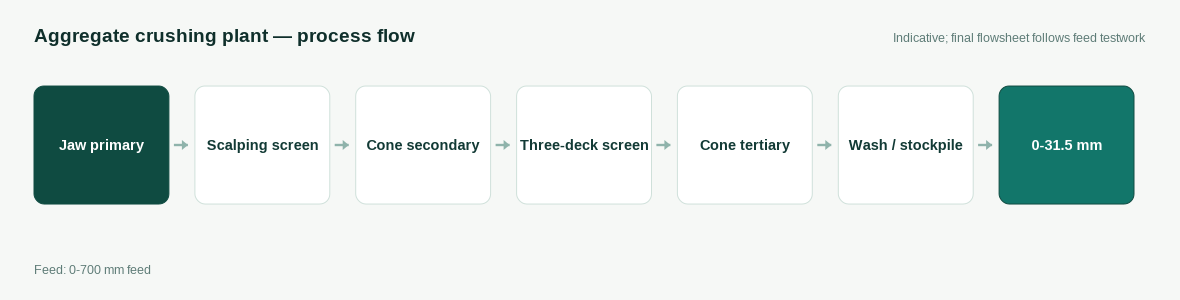
A 300 t/h granite line making 0-5, 5-10, 10-20 and 20-31.5 mm aggregate from 0-700 mm quarry feed looks simple on a flowsheet, and rarely is. Three numbers decide it: Bond work index (12-20 kWh/t for granite, up to 22 for basalt), abrasion index, which decides whether manganese or chrome white iron survives the chamber, and the flakiness limit the buyer actually enforces.
Design basis: what the feed actually is
Testing before quotation is not decoration. A 20 kg sample and a Bond work index test cost far less than rebuilding a secondary chamber, and they turn a guess into a number you can defend to a bank. We ask for top size distribution, work index, abrasion index, clay and moisture, and the target grading with its tolerance.
| Parameter | Typical range | What it changes |
|---|---|---|
| Feed top size | 0-600 mm, up to 0-800 mm | Primary opening, hopper volume, feeder width |
| Bond work index | 12-22 kWh/t | Installed kW, reduction split between stages |
| Abrasion index | 0.2-0.6 | Chamber profile, liner alloy, wear cost per tonne |
| Feed moisture | 1-6 percent | Screen aperture, washing need, blinding risk |
| Clay and fines | 3-15 percent passing 5 mm | Scalping, water demand, pond sizing |
| Bulk density | 1.5-1.8 t/m3 | Conveyor width, stockpile and silo loads |
| Flakiness limit | 15-25 percent by mass | Whether an impactor is needed at all |
The work index sets power; the abrasion index sets the maintenance budget, and the two do not correlate. High work index with low abrasion rewards a cone on manganese. Moderate work index with high abrasion punishes any impactor. Moisture above 4 percent changes screen aperture choice and is the usual reason a plant misses capacity on a wet morning.
Two stages or three
Jaw plus cone suits limestone-like rock, modest reduction and sub-base product. Three stages, with secondary cone and tertiary cone or VSI in closed circuit, appear when 5-10 and 10-20 mm clean stone are sold separately and flakiness is tight. If 700 mm must reach 20 mm and a cone cannot exceed about 4:1 per pass, a third stage is required.
Choosing the reduction machine
Primary: jaw for hard abrasive rock to 800 mm, because the compression chamber tolerates slabs and wear parts are cheap per tonne; gyratory above roughly 500 t/h, where uptime beats capital. Secondary: standard or coarse cone for granite and basalt, since laminated breakage gives denser, more cubical product at lower liner cost than impact. HSI fits soft to medium rock with abrasion below about 0.3 and cubicity as the priority;.
Tertiary: short-head cone in closed circuit for shape, or VSI where the flakiness limit is severe. VSI costs more power per tonne and makes more fines, so it is chosen by specification, not habit. Screens: three-deck inclined units, polyurethane or rubber media, apertures 10-15 percent above the nominal cut to allow for moisture.
Circulating load is designed, not discovered. Closed tertiary circuits run 60-120 percent; below 50 the screen is oversized, above 150 the crusher bottlenecks. We size the deck on fresh feed plus circulating load and print the assumption on the flowsheet.
Shape, dust, water, stockpiles
Cubicity follows reduction ratio and chamber geometry. Keep cone reduction below 4:1 and the chamber choke-fed; granite then lands at 10-18 percent flakiness. At 6:1 the slab count climbs, and a VSI becomes cheaper than rejected product.
Dust control is two systems with two budgets. Sprays at transfer points and crusher discharge hold the plume down at 0.5-1.5 m3/h per point, limited by the moisture screens tolerate. A baghouse answers permits written in mg/m3: size on total exhaust, typically 8,000-25,000 m3/h at 300 t/h, at an air-to-cloth ratio of 1.0-1.2 m/min on pulse-jet bags.
Washing is a separate decision. Clay passing 5 mm above about 5 percent needs a washing screen or log washer at 1.0-2.0 m3 per tonne washed, mostly recovered; that number drives thickener area, pond volume and make-up water, and it is the item most often missing from a first budget.
Stockpiles follow the loader. Conical piles give 300-800 t live and segregate; a reclaim tunnel costs more but blends. Size live capacity at 8-12 hours of each product.
Power, capacity and capex
Three-stage hard rock runs 1.1-1.6 kW per t/h installed: 300 t/h is 380-480 kW connected, with diversity 0.75-0.85 for the supply agreement. Bands below are indicative for equipment engineered in Zhengzhou and built with selected partner factories in Henan, shipped as modules; freight, duty and local erection are excluded.
| Scope | 150 t/h | 300 t/h | 500 t/h |
|---|---|---|---|
| Primary station, feeder and hopper | 140,000-190,000 | 210,000-290,000 | 320,000-430,000 |
| Secondary and tertiary crushers | 260,000-360,000 | 480,000-680,000 | 780,000-1,050,000 |
| Screens, conveyors and chutes | 180,000-250,000 | 330,000-460,000 | 540,000-720,000 |
| Civils and steel structure | 220,000-300,000 | 400,000-560,000 | 650,000-880,000 |
| Electrical, control and cabling | 90,000-130,000 | 160,000-230,000 | 260,000-360,000 |
| Dust, baghouse and water systems | 70,000-110,000 | 130,000-190,000 | 210,000-300,000 |
| Total installed, indicative | 960,000-1,340,000 | 1,710,000-2,410,000 | 2,760,000-3,740,000 |
Layout, civils and power distribution
Layout follows two constraints: the angle at which a conveyor lifts damp aggregate without rollback, and the turning circle of the largest site truck. Primary-to-secondary transfer stays below 18 degrees, walkways are 1.2 m each side.
Civils carry surprising loads. A 300 t/h plant puts 60-120 t static on the primary foundation plus dynamic factors of 1.5-2.0. The cone foundation needs 3-5 times crusher mass to absorb stroke. Screen steel takes 1.0 kN/m2 live plus wind, and chutes are lined above 6 m/s impact.
Commissioning hold points and acceptance
- Foundation and anchor survey signed before grouting.
- Four-hour no-load run of every motor, temperatures logged.
- Closed-side setting verified by lead pour, not by gauge.
- Screen stroke and amplitude checked loaded and empty.
- Water and dust systems balanced at design flow.
Acceptance runs 72 hours at the stated setting. Capacity comes from a belt scale over a full shift; grading is sampled from each stockpile and flakiness is tested on the 10-20 mm fraction. Availability of 85 percent with sustained capacity is the pass mark; anything short becomes a punch item with an owner and a date.
Questions we answer before quotation
Can one plant make sand and aggregate?
Yes, by adding a VSI and a split screen after the tertiary. Sand reduces aggregate yield and roughly doubles the fines you must capture or sell.
How long does erection take?
Ten to fourteen weeks for 300 t/h on a prepared site with local labour and one supervisor.
Can it run on generators?
Yes, at 1.25 times connected load with soft start or a VFD.
Send top size distribution, work index, abrasion index, moisture, clay and the grading you must sell. We return a flowsheet, a power schedule and a capex band against those numbers, and say where the risk sits.