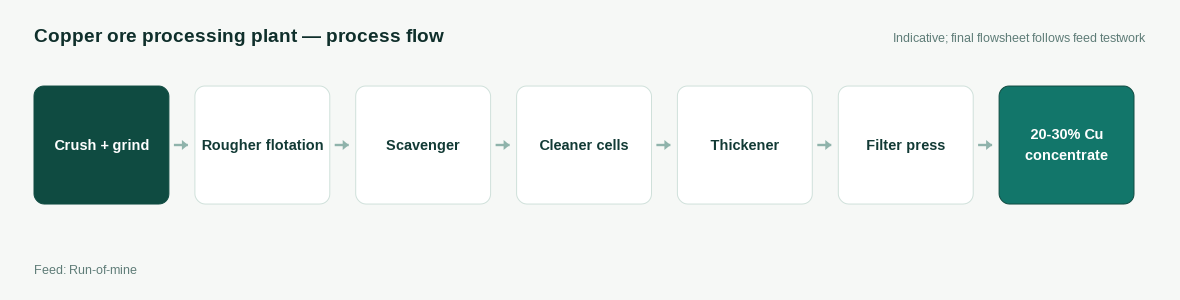
A 1,000 t/day copper plant at 0.6 percent Cu contains six tonnes of metal in each day’s feed. At 88 percent recovery and a 25 percent concentrate, that is about 21 tonnes of concentrate and 0.7 tonnes of copper reporting to tailings every day. The design problem is not to float everything; it is to choose the grind, reagent mix and circuit arrangement that hold grade and recovery on the same curve.
Design basis: mineralogy sets the route before throughput does
Copper oxide and copper sulphide are different businesses sharing a gatehouse. We need a full assay, copper mineral speciation, acid-soluble versus total copper, pyrite and gangue mineralogy, Bond work indices, clay content, moisture, and any gold or silver credit. Bottle-roll and locked-cycle flotation tests are the minimum before a flowsheet is frozen.
| Parameter | Design range | Consequence |
|---|---|---|
| Throughput | 200-2,000 t/day | Cell volume, mill power, crew |
| Head grade | 0.3-1.5 percent Cu | Concentrate tonnage, cut-off economics |
| Copper mineralogy | Chalcopyrite, chalcocite, malachite, chrysocolla | Flotation versus leach, acid demand |
| Oxide fraction | 0-100 percent | Route selection, tails treatment |
| Pyrite | 1-10 percent S | Depressant, pH, concentrate grade |
| Grind target | P80 75-150 µm | Liberation, regrind, energy |
| Bond ball work index | 10-18 kWh/t | Mill size and installed kW |
| Clay and moisture | 2-15 percent, 3-10 percent | Handling, filtration, water |
Two routes, one decision tree
Oxide and mixed ores go to heap or agitated leach followed by solvent extraction and electrowinning, with acid demand set by carbonate gangue. Sulphide ores go to flotation, and the concentrate is sold or further treated. A mixed ore is not automatically a flotation feed: if a third of the copper is oxide, flotation tails still carry acid-soluble metal, and test work has to say whether leaching those tails pays for the extra circuit.
For sulphide, crushing to 12 mm is followed by grinding to P80 75-150 µm. Rougher flotation runs 10-15 min, scavenging 8-12 min, and two cleaner stages with a regrind to P80 38-45 µm produce the final grade. pH is held at 10-12 with lime; collector dose is 25-60 g/t, frother 10-25 g/t, and a silicate or polymeric depressant 200-800 g/t where gangue slimes report to concentrate. Superficial air velocity sits at 1-2 cm/s, and total residence is 25-35 min.
Concentrate is thickened to 60-65 percent solids and filtered to 8-10 percent moisture; a pressure filter is justified when the smelter penalises water. Tailings go to a dam or dry stack, with 70-85 percent of water recycled. Oxide leach uses 15-40 kg/t acid in a heap, a pregnant solution of 1-4 g/L Cu, 90-95 percent extraction in the SX circuit, and 1,800-2,200 kWh per tonne of cathode in electrowinning.
Equipment selection: residence, lip load and the regrind mill
Flotation cells are chosen on residence time and lip load, not on brand. A cell that is too shallow froths over; one that is too deep loses coarse particles off the bottom. The regrind mill is the grade lever: grinding cleaner feed finer raises concentrate grade but flattens recovery if it goes past liberation. Vacuum filtration is adequate for 10 percent moisture; pressure filtration is the answer when the smelter wants 8 percent. Slurry pumps should be selected on head at design density, because a pump sized on water will cavitate on 40 percent solids.
Grade and recovery: the trade the smelter contract decides
| Concentrate grade | Typical recovery | Where it fits |
|---|---|---|
| 20 percent Cu | 92-94 percent | Low-grade ore, maximum metal recovery |
| 24 percent Cu | 90-92 percent | Balanced circuit, modest cleaning |
| 27 percent Cu | 87-90 percent | Standard smelter feed |
| 30 percent Cu | 82-87 percent | High-grade contract, more cleaning and regrind |
Each point of concentrate grade above roughly 25 percent usually costs 0.5-1.5 points of recovery. Whether that trade pays depends on treatment charges, freight and the offtake penalties, not on a preference for a clean number.
Energy, reagents and cost per tonne
| Item | Use per tonne | Cost per tonne |
|---|---|---|
| Collector | 0.025-0.06 kg | $0.10-0.35 |
| Frother | 0.01-0.025 kg | $0.03-0.10 |
| Lime | 1-5 kg | $0.15-1.00 |
| Grinding media | 0.6-1.5 kg | $0.55-1.95 |
| Power | 18-30 kWh | $1.10-3.60 |
| Labour and maintenance | — | $2-6 |
| Total | — | $4-13 |
Add SX-EW reagents, acid and cathode handling for oxide ore; acid alone can add $5-15/t at 20-40 kg/t. Capex bands for a complete flotation plant, excluding the tailings dam and mobile fleet, run about $1.2-2.8M at 200 t/day, $3-6M at 500 t/day, $6-11M at 1,000 t/day and $11-20M at 2,000 t/day. A matched SX-EW circuit adds roughly $2-5M, depending on cathode capacity.
Layout, civils, power and water
A 1,000 t/day flotation plant occupies 0.8-2 ha including concentrate pad and tailings thickener. Connected power is 500-900 kW; grinding takes 60-70 percent of it. Water demand is 0.5-1.5 m3/t, with recycle from the tailings thickener overflow. Civils must carry the heaviest cell and mill loads on a separate raft, and the tailings line should be routed above ground with accessible flanges rather than buried.
Test work before the flowsheet is frozen
Bottle-roll tests screen oxide leach conditions; locked-cycle flotation tests establish the grade-recovery curve at steady state, which a single batch test cannot. Mineralogy identifies locked and liberated particles, and settling tests size the thickener. We will not guarantee a flowsheet on a grab sample, and a bankable study should not accept one either.
Commissioning and acceptance
- Water test and interlock check on every pump, cell and thickener drive.
- Ore commissioning at 50 percent feed, with grind, pH and reagent addition tuned.
- 72-hour acceptance run at design throughput, recovery and concentrate grade; moisture on filter cake checked together.
- Tailings density, thickener overflow clarity and recycle rate verified.
- Handover with a mass balance reconciled to the belt scale and assay.
Common questions
Can one plant treat oxide and sulphide?
Only with a deliberate campaign strategy. Blending a small oxide fraction into sulphide feed is common; switching the whole circuit between flotation and leach is not, because the grinding, reagent and water systems want different conditions.
What grade can a small plant hold?
At 200-500 t/day, 22-26 percent Cu is realistic with two cleaning stages and a regrind. Higher grades need more cleaning, finer regrind and tighter operator control than a small crew can sustain around the clock.
Heap or agitated leach for oxide?
Heap leach suits 2,000 t/day and above with coarse feed and available land; agitated leach suits higher-grade, fast-leaching oxide at smaller tonnage, where recovery matters more than operating simplicity.
Send the assay, mineralogy and target concentrate spec, and we will return a mass balance, reagent schedule and budget. From Zhengzhou, MSK engineers the process and sources equipment from selected partner factories in Henan; commissioning is handled by our own team.