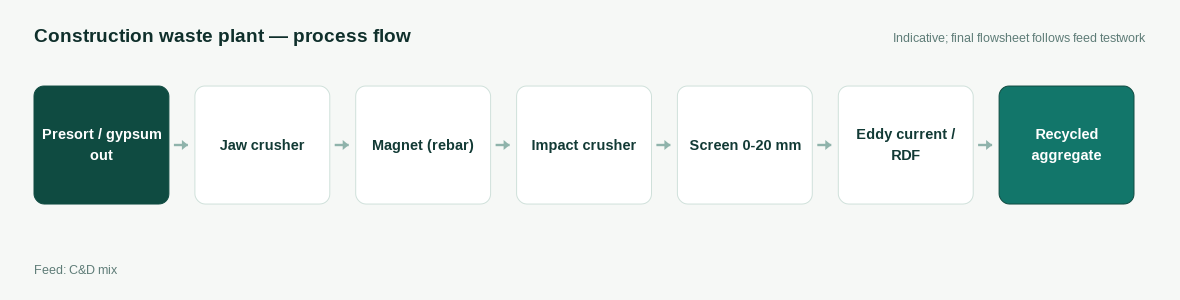
A 300 t/h construction and demolition line inside a city receives 15-25 truckloads an hour and has to turn mixed rubble into three or four saleable grades while keeping dust below the fence line and noise under the night limit. Feed is never clean concrete: it arrives with rebar, plasterboard, timber, plastic and fines that behave like soil.
Design basis: the C&D mix, not the crusher, sets the plant
We ask for a week of weighbridge records, a sieve analysis of the as-received material, and a hand-sorted composition sample. The numbers below are typical of urban demolition in a Chinese provincial city; your own sample should replace them before layout.
| Fraction | Typical share | Effect on the line |
|---|---|---|
| Concrete rubble | 40-65 percent | Crushing energy, product strength |
| Brick and masonry | 15-30 percent | Water absorption, brick content limit |
| Rebar and ferrous | 2-5 percent | Magnet duty, jaw wear, blockages |
| Gypsum board | 1-3 percent | Sulphate, screening, RDF quality |
| Timber and plastic | 3-7 percent | RDF yield, manual sorting load |
| Fines below 5 mm | 10-20 percent | Washing, dust, stockpile volume |
| Moisture | 5-12 percent | Screen blinding, belt capacity |
Flowsheet: two stages, three products, four nuisance streams
Feed is tipped into a 30-40 m3 hopper with an apron feeder and a grizzly that scalps the fines before crushing. A manual picking cabin removes timber, plastic and gypsum board; a trained crew here is cheaper than a machine that cannot see a painted board. Primary crushing uses a jaw set at 80-120 mm, followed by an overband magnet and a second magnet after the impact crusher. Screening splits 0-5, 5-10, 10-20 and, where the market wants it, 20-31.5 mm. An eddy current separator recovers aluminium and copper from the 5-20 mm stream. Light waste, 10-20 percent of feed at 12-18 MJ/kg, is baled as refuse-derived fuel when chlorine stays below 1 percent.
Two-stage mobile lines of 100-200 t/h suit demolition sites with a short life and tight permits; a fixed 300-500 t/h line has lower opex, better dust control and higher recovery, but needs a 15-20 year site and a larger consent.
Equipment selection: where wrong choices show up as downtime
A jaw crusher tolerates rebar and unknown lumps; an impactor makes a better-shaped product but wraps rebar around its rotor and needs a shear or a very reliable magnet upstream. The first magnet belongs over the conveyor after primary crushing, where the belt is thin and the burden shallow; the second catches what the crusher liberated. An eddy current separator only works on a dry, narrow size fraction, so it belongs after screening, not in the main flow.
Gypsum board must leave before crushing. It blinds screens, raises sulphate in aggregate, contaminates RDF and creates irritating dust. A picking station and a gypsum chute are the cheap fix; a ballistic separator is the expensive one. Washing the 0-5 and 5-10 mm products reduces chloride and sulphate enough for structural reuse, at 0.5-1.5 m3/t and a settling pond or filter press.
Product grading and the brick limit
| Product | Typical use | Limit to watch |
|---|---|---|
| 0-5 mm recycled fines | Pipe bedding, sub-base, brick making | Fines content, chloride, organic matter |
| 5-10 mm recycled aggregate | Concrete blocks, drainage | Brick content, water absorption |
| 10-20 mm recycled aggregate | Non-structural concrete, road base | Brick content below 10 percent for most specs |
| 20-31.5 mm | Sub-base, fill | Oversize, contamination |
Brick content is the number buyers ask about. Many specifications allow 5 percent for the highest class, 10 percent for general structural use and 15 percent for lower-grade applications; above that the aggregate is road base, not concrete. Chloride should stay under about 0.06 percent and sulphate under 1.0 percent for concrete use, which is why washing and gypsum removal are process steps rather than housekeeping.
Dust, noise and the urban fence line
At the boundary, dust is usually held to 10-20 mg/m3 and workplace exposure to 1-5 mg/m3; noise limits commonly run 55-65 dB(A) by day and 45-55 dB(A) at night. The practical package is enclosure of crushers and screens, water sprays at transfer points, rubber curtains, swept traffic areas and a wheel wash. Noise walls help, but a gap around a chute leaks more than a wall absorbs.
Footprint, truck cycle and stockpiles
A 300 t/h fixed line needs 4,000-8,000 m2 including stockpiles, workshop and office. At 2,400 t/day, three days of product storage is 7,200 t, which is a real pile, not a corner. Truck turnaround should be designed at 25-30 min with two weighbridges and separate inbound and outbound lanes; a single bridge turns a 120-truck day into a queue.
Capex and opex per tonne
| Configuration | Throughput | Capex band | Opex band |
|---|---|---|---|
| Mobile two-stage | 100-150 t/h | $0.4-0.9M | $4-8/t |
| Fixed two-stage | 200-300 t/h | $2-4M | $3-6/t |
| Fixed with washing and RDF | 300-500 t/h | $4-7M | $3.5-7/t |
Opex is dominated by power, wear parts, labour and residue disposal. Wet feed raises all four; a washing circuit adds water and sludge handling that the capex line rarely captures.
Permits and commissioning acceptance
The consent package normally covers environmental impact, noise and dust limits, waste processing and storage, stormwater discharge and site planning. Commissioning starts with a no-load run, then load testing at 50 and 100 percent. Acceptance is measured on product grading, brick content by hand sorting, boundary dust and noise, and a 72-hour run at design throughput. The last test is a week of real deliveries, not a prepared sample: count the stoppages.
Common questions
Can I crush gypsum board with the concrete?
No. It contaminates aggregate, coats screens and puts sulphate into both product and RDF. Remove it at the picking station and send it to a dedicated recycler.
How much brick is acceptable?
It depends on the buyer: 5-10 percent for concrete aggregate, up to 15 percent for lower-grade uses. Above that, sell the material as road base and stop pretending it is structural aggregate.
Mobile or fixed for a 100 t/h site?
Mobile if the site life is under three years or the permit is temporary. Fixed if you have land, a long lease and a steady waste stream, because opex and dust control are both better.
Why wash the fines?
Washing lowers chloride and sulphate, removes attached mortar and improves concrete performance. It also creates a sludge stream that must be settled, pressed and disposed of, so budget for it before promising a clean product.
Send your composition sample, target products and site plan, and we will return a flowsheet, equipment list and budget. MSK is a Zhengzhou-based supplier of recycling equipment, working with selected partner factories in Henan and handling layout and commissioning ourselves.