A 200 t/day gold plant on 4.1 g/t ore carries about 26 ounces of gold into the leach every day. At 92 percent recovery that is 24 payable ounces; at 86 percent it is 22.4. The 1.6-ounce gap is roughly the daily reagent bill. Every tank, screen and pump must either liberate gold or keep it out of the tailings.
Design basis: deportment decides more than grade
We ask for a fire assay, a screen assay by size class, a diagnostic leach, sulphide sulphur, cyanide-soluble copper, organic carbon, silver, clay, moisture and a Bond ball mill work index before fixing a flowsheet. Thirty kilograms of composite and a bottle-roll test answer most layout questions.
| Parameter | Design range | What it changes |
|---|---|---|
| Throughput | 50-500 t/day | Mill size, tank count, crew |
| Head grade | 1.5-8 g/t Au | Economics, security, residence time |
| Gold deportment | Free, sulphide-locked, carbonaceous | Gravity, flotation, oxidation step |
| Grind target | P80 75-106 µm | Mill power, liberation, slime losses |
| Sulphide sulphur | 0.5-6 percent S | Cyanide and oxygen demand |
| Cyanide-soluble copper | 0.02-0.5 percent Cu | NaCN consumption and cost per tonne |
| Bond ball work index | 12-20 kWh/t | Installed grinding power |
| Feed moisture | 2-8 percent | Crushing, stockpile, dust control |
Flowsheet: gravity takes the coarse gold, CIL takes the rest
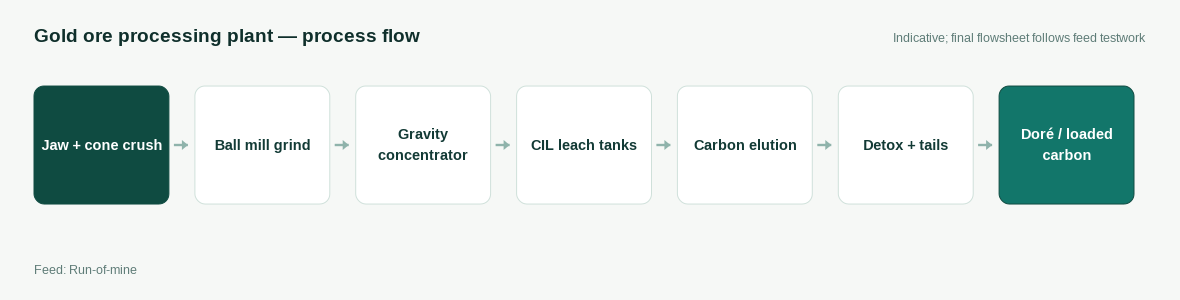
A single-toggle jaw and a cone in closed circuit reduce run-of-mine ore to 10-12 mm. The stockpile is covered to keep feed moisture stable.
A ball mill with cyclones grinds to P80 75-106 µm. The target comes from the screen assay: gold above 106 µm that is free does not need finer grinding, while values locked in the 20-50 µm band with sulphide may need a finer cut, and the mill power rises with it.
Cyclone underflow, 15-30 percent of the circulating load, feeds a centrifugal concentrator. Its concentrate is cleaned on a shaking table, and the table concentrate, often 40-60 percent of the gravity-recoverable gold, goes to an intensive leach reactor or direct smelt.
The combined tail is thickened to 45-50 percent solids and limed to pH 10.5-11. Eight to ten CIL tanks give 24-48 h residence at 0.05-0.1 percent NaCN, held by automatic titration with dissolved oxygen above 6 mg/L. Carbon at 20-30 g/L advances counter-currently, one tank per day, and is eluted at 3,000-7,000 g/t loaded. Stripping uses hot caustic in an AARL column; electrowinning and smelting close the doré balance.
Tailings are detoxified with SO2/air and a copper catalyst, or with peroxide, until weak-acid-dissociable cyanide falls to the permitted 10-50 mg/L. The slurry then goes to a lined, zero-discharge pond with return water pumped back to the mill.
Equipment selection: buy against failure modes, not catalogue size
A cone crusher earns its capital on abrasive ore; an impactor is cheaper to buy and dearer to run. The concentrator is sized on underflow volume rather than plant tonnage, because an undersized unit fluidises badly and loses the coarse gold it was bought for. Carbon transfer with a centrifugal pump fractures granules and blinds the elution column, so use a dedicated carbon pump or an air lift. A 10-12 m thickener at 200 t/day holds CIL density steady and keeps carbon out of the pond.
Recovery by ore type
These are planning ranges, not a guarantee for your sample.
| Ore type | Typical recovery | Route |
|---|---|---|
| Free-milling quartz with coarse gold | 92-96 percent | Gravity plus CIL, 0.3-0.6 kg/t NaCN |
| Sulphide-associated pyrite or arsenopyrite | 85-92 percent | Flotation, concentrate regrind then CIL |
| Refractory, gold locked in sulphide | 65-85 percent | Bio-oxidation or pressure oxidation before cyanide |
| Carbonaceous, preg-robbing | 70-85 percent | Carbon blinding or flotation ahead of leach |
| Oxidised, clay-rich | 88-94 percent | Washing, higher lime, shorter residence |
Reagent cost per tonne and per ounce
| Item | Use per tonne | Unit cost | Cost per tonne |
|---|---|---|---|
| Sodium cyanide | 0.3-0.9 kg | $2.8-3.6/kg | $0.8-3.2 |
| Lime | 1.5-4 kg | $0.12-0.20/kg | $0.2-0.8 |
| Grinding media | 0.8-2.0 kg | $0.9-1.3/kg | $0.7-2.6 |
| Activated carbon | 0.02-0.06 kg | $2.5-4.0/kg | $0.1-0.2 |
| Power | 25-45 kWh | $0.06-0.12/kWh | $1.5-5.4 |
| Labour and maintenance | — | — | $3-7 |
| Total | — | — | $9-22 |
At 4 g/t and 92 percent recovery, a tonne holds 0.118 oz, so $9-22/t is roughly $76-186 per ounce before mining and refining.
Capex bands for a complete plant
Prices cover crushing, grinding, gravity, CIL, elution and detox, excluding mining fleet and working capital.
| Throughput | Capex band | Typical scope |
|---|---|---|
| 50 t/day | $0.35-0.7M | Crushing, mill, eight CIL tanks, pond |
| 100 t/day | $0.7-1.4M | Larger mill, gravity, elution, detox |
| 200 t/day | $1.2-2.4M | Full circuit, laboratory, camp |
| 500 t/day | $2.5-4.5M | Two milling lines, automated leach |
Layout, water and power
A 200 t/day plant needs 0.5-1.5 ha: stockpile, mill hall, leach and CIL, elution, reagent store, detox and pond. Connected power is 250-350 kW at 200 t/day and 500-700 kW at 500 t/day. Water demand is 0.4-1.0 m3/t, with 70-80 percent recycled from the pond, and the cyanide store needs bunding and an emergency shower.
Permits and tailings management
Expect an environmental impact assessment, a water abstraction or discharge consent, cyanide transport and storage licensing, and a tailings facility designed and signed by a qualified engineer. The pond is not an afterthought: size it for the wet season plus a 30-year storm, line it with HDPE, leave visible freeboard, and install monitoring boreholes before the first pour.
Commissioning hold points
- Mechanical completion and water test: every pump, tank and pipe runs on water without leaks, at the design flow.
- Ore commissioning at 50 percent feed: grind curve, gravity recovery, leach pH and cyanide strength.
- 72-hour run at design throughput, with recovery within three points of the locked test work.
- Carbon advance, loading and elution efficiency, with the doré balance closed.
- Detox verification and pond integrity, including return-water quality.
Common questions
How fine should the grind be?
P80 75-106 µm covers most free-milling ores. The screen assay sets the final number, because a blanket rule either overgrinds or leaves locked gold in the tail.
Is gravity worth it at 50 t/day?
If a pan test shows free gold, yes. A concentrator and table add roughly $25,000-60,000 and often pay back within weeks.
Why not heap leach at this scale?
At 50-500 t/day the pad, liner, irrigation and solution management rarely justify the lower recovery. Vat or agitated leach is faster and more controllable, and the tailings are easier to contain.
What drives cyanide consumption?
Copper, sulphur and oxygen demand. A cyanide-soluble copper figure above 0.1 percent changes the reagent budget, and sulphide sulphur above 2 percent usually calls for pre-aeration or flotation.
Send the assay, deportment and throughput target, and we will return a mass balance, flowsheet and budget price. MSK supplies gold plant equipment from Zhengzhou and builds through selected partner factories in Henan, with our engineers on site through commissioning.