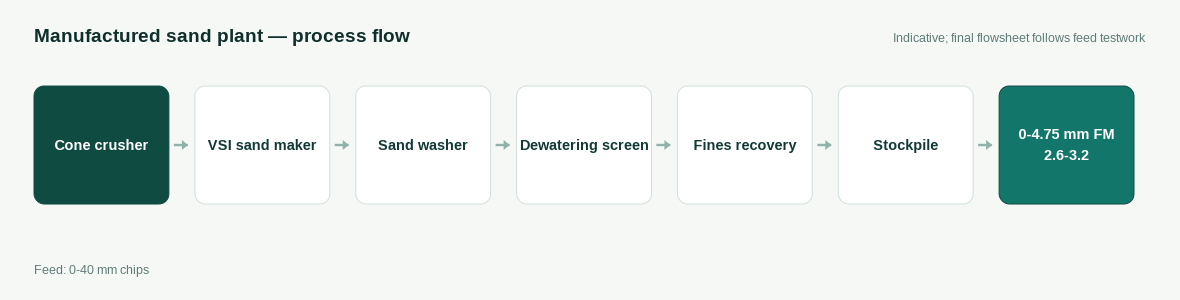
A 150 t/h manufactured sand plant is not a crusher with a screen bolted on. The governing document is a grading envelope: fineness modulus 2.6-3.2, micro-fines below 75 micrometres held inside 3-15 percent, sand equivalent above 75 for concrete work, and stockpile moisture the batching plant can live with. Two of those pull against each other, because more fines lift the FM and the cohesion until they start demanding extra water, and the plant design is the negotiation between them.
Design basis: rock, grading, clay
Crusher dust is not a design basis. We test the feed for grading, clay content, sand equivalent and moisture, then set the VSI circuit and the classification method against the sand specification rather than the quarry’s convenience. A feed carrying 12 percent clay needs washing regardless of how good the grading looks on paper.
| Parameter | Target or range | Why it governs |
|---|---|---|
| VSI feed size | 5-20 mm, or 0-5 mm dust | Rotor diameter, cascade ratio, reduction per pass |
| Target fineness modulus | 2.6-3.2 | Screen cut, fines return, blend ratio |
| Micro-fines under 75 um | 3-15 percent | Classifier setting, water or air volume |
| Sand equivalent | 75 minimum for concrete | Washing intensity, clay removal |
| Product moisture | 3-6 percent at stockpile | Dewatering equipment, conveyor design |
| Sand yield from feed | 40-60 percent | Circuit balance, circulating load |
Why cone crushers make poor sand
A cone breaks by compression between liners, producing flaky, elongated particles and a grading that is either too coarse or, at a tight setting, dominated by dust. For aggregate that passes. For sand it fails: flaky grains raise concrete water demand and cut strength at fixed cement content, and a curve with 40 percent in one sieve cannot be blended into FM 2.6-3.2. A VSI breaks by rock-on-rock or rock-on-anvil impact, giving equant particles and a continuous curve. That is why the VSI sits in the sand circuit and the cone does not.
Flowsheet, stage by stage
Feed preparation screens at 20 mm, removing oversize and trash. The VSI runs rock-on-rock where shape and wear cost matter, or rock-on-anvil where extra fines are wanted; the choice is a rotor and anvil configuration, not a different machine. Discharge goes to a closed-circuit screen at 4.75 mm, with oversize returning at 100-200 percent circulating load. Below 100 percent the rotor is underused; above 200 the screen becomes the limit.
Undersize then splits by process route. A bucket wheel or screw washer removes clay and excess fines with 1.0-2.5 m3 of water per tonne, and the sand is dewatered to 8-12 percent moisture before stockpiling. An air classifier does the same job dry, cutting at 75 um with a dynamic rotor, and suits plants where water is scarce or the sand feeds a dry mortar line. It cannot remove clay; that must be washed out upstream.
Water, slurry balance and ponds
Wash water dominates the services design. At 150 t/h with 2 m3 per tonne, the plant moves 300 m3/h of slurry carrying 8-20 t/h of fines. The thickener is sized on that volume plus a storm allowance, flocculant dosing runs 20-60 g per tonne of solids, and the return line is designed for 85-90 percent recovery. Silt ponds are sized for the fines that will not settle plus a wet season, never for average conditions alone.
Energy, output and capex
VSI sand circuits draw 8-15 kWh per tonne of product, higher with rock-on-anvil and a tight cut. Installed power for 150 t/h is 180-280 kW including washing and pumps, or 380-520 kW connected at 300 t/h. Bands below are indicative for equipment engineered in Zhengzhou and built with selected partner factories in Henan.
| Scope | 50 t/h | 150 t/h | 300 t/h |
|---|---|---|---|
| VSI and feed preparation | 90,000-130,000 | 180,000-250,000 | 320,000-430,000 |
| Washing and dewatering | 60,000-100,000 | 130,000-200,000 | 240,000-340,000 |
| Thickener, recycling and pond works | 50,000-80,000 | 110,000-170,000 | 200,000-300,000 |
| Screens, conveyors and structure | 80,000-120,000 | 170,000-240,000 | 300,000-420,000 |
| Electrical, control and cabling | 40,000-60,000 | 80,000-120,000 | 140,000-200,000 |
| Total installed, indicative | 350,000-550,000 | 900,000-1,400,000 | 1,600,000-2,600,000 |
Layout, civils and power
Wet sand layout is a drainage problem first. All floor areas slope to a sump, the thickener sits below the washer so slurry flows by gravity, and the stockpile area is paved with a fall to a collection channel. Conveyors carrying damp sand run at 14 degrees rather than 18, with belt cleaners at every discharge.
On civils, the VSI foundation takes 4-6 times machine mass to absorb rotor imbalance, the washer and thickener usually sit on a raft, and stockpile walls are designed for a 60-degree angle of repose with live load surcharge. Power: VFD on the VSI and the main pump, motors in IP55, and a control philosophy that interlocks wash water ahead of feed.
Commissioning and acceptance
- Rotor balanced and anvil gap set before first feed.
- Cascade and recirculation proven at design load.
- Water balance closed: make-up equals losses plus product moisture.
- Thickener and flocculant tuned on real slurry, not clean water.
Acceptance is 72 hours at rated capacity with FM within plus or minus 0.15 of target, micro-fines inside the agreed window, sand equivalent at or above specification, and product moisture below 12 percent at the stockpile. Grading is sampled every four hours, and those results form the acceptance record.
Questions we answer before quotation
Do I need washing if the feed is clean?
Not always. Below about 3 percent clay, with sand equivalent already above 75, dry classification can be enough.
How much water does it consume?
1.0-2.5 m3 per tonne washed, of which 85-90 percent is recovered; net make-up is 0.15-0.35 m3 per tonne.
Can the same plant make plaster sand?
Yes, with a second classification cut and a tighter fines window, usually by splitting the classifier overflow.
What limits capacity?
Usually the screen and the water circuit, not the VSI. We size both on circulating load.
Send the feed grading, clay content, sand equivalent and the concrete or plaster specification you sell against. We will size the rotor, the water balance and the capex band, and flag where the grading envelope is unrealistic before you buy steel.