Frame removal is the cheapest station on a PV recycling line and the one most often staffed by hand long after the rest of the plant has been automated. That is a mistake with a measurable cost. On a 300-module shift the gap between manual and automatic removal is 0.5–0.7 USD per module in labour, before counting the 15–25% of frames that leave bent and sell at scrap rather than extrusion grade. At 1,000 modules per shift manual removal needs seven operators, cannot keep pace with the line, and the gap widens to nearly 1 USD per module.
What frame removal has to achieve
The frame is a 6063-T5 extrusion, 30–50 mm deep and 1.6–2.2 mm wall, weighing 1.8–2.6 kg by format, held by a silicone bead along the inner flange and by the extrusion’s own lip. Removal must break that bead and spring the lip without loading the glass edge, because a chipped 3.2 mm tempered sheet cannot be sold for reuse.
The output specification is simple: frame off in one piece, under 5% bent, glass edge intact, junction box still attached so it can be removed at the next station. Every method below is judged against those conditions, not cycle time alone.
Manual removal
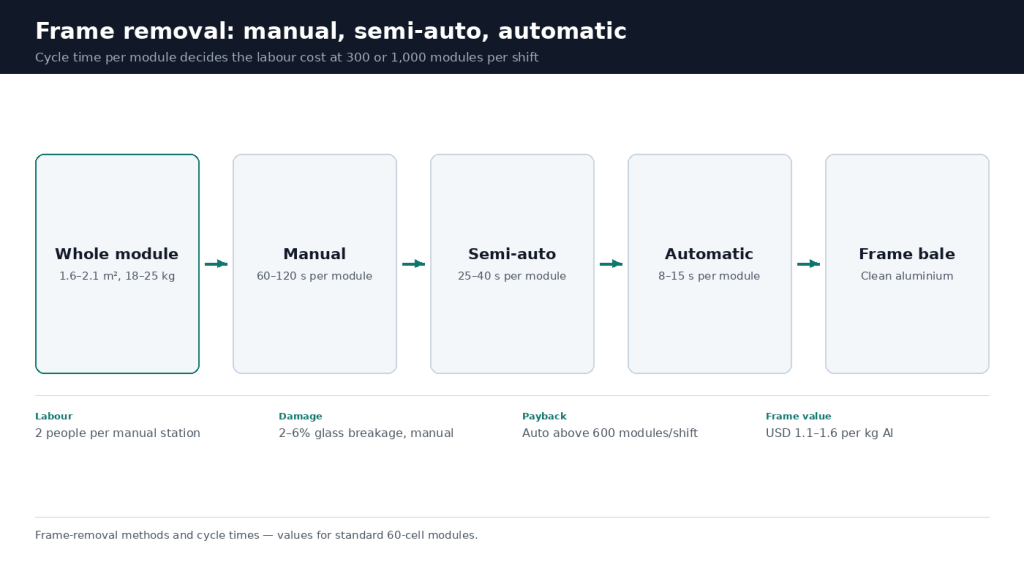
A pry bar, a mallet and a knife. The operator cuts the silicone at two corners, inserts the bar under the frame lip and walks it around the perimeter, then lifts the frame off. Cycle time is 45–90 seconds for an experienced worker, and the frame bends at the corner in 15–25% of attempts because the bar applies a point load where the extrusion is thinnest.
Throughput per person is 25–35 modules per hour, so a 300-module shift needs two operators at the station and a third clearing frames, and a 1,000-module shift needs six to seven. Injury risk is real: the bar slips and the frame edge is sharp.
Manual removal is still correct below 100 modules per shift, on heavily damaged or mixed feed, and where the glass goes to cullet and frame straightness does not matter.
Semi-automatic: corner cutters and band saws
A pneumatic corner cutter notches the four corners in 4–6 seconds each, after which the sections lift off by hand. Cycle time with handling is 25–40 seconds, throughput 90–140 per hour, and frame damage falls to 5–10% because the corner is cut rather than forced.
A band saw station cuts one longitudinal slot per side instead: 15–25 seconds on large formats, but it produces swarf that sells below clean extrusion grade.
Capital cost is 8,000–25,000 USD, which is the reason this class dominates plants in the 300–600 modules per shift range. Its cost is the best of the three at 300 modules per shift and the worst at 1,000, because labour still scales with module count.
Automatic four-ram removal
Four hydraulic rams engage the frame corners simultaneously, spread the extrusion clear of the laminate, and a fifth axis lifts the frame away. Cycle time is 8–15 seconds, throughput 240–400 modules per hour with one operator loading and one unloading, and frame damage falls below 5% because the load is distributed around the perimeter instead of applied at a point.
The machine needs the module presented square and at a known format, so either a format-detect station or a manual selector. Mixed feed costs 10–15% of throughput in changeover, and a badly bent frame can jam the ram, hence a bypass for damaged units.
Capital cost is 35,000–90,000 USD depending on axes and conveyor integration, and that only works above roughly 500 modules per shift.
| Method | Cycle time | Throughput per shift | Operators | Frames bent | Cost per module, 300/shift | Cost per module, 1,000/shift |
|---|---|---|---|---|---|---|
| Manual, pry bar | 45–90 s | 200–280 | 3 | 15–25% | 1.05–1.30 USD | not viable, 7 operators |
| Corner cutter | 25–40 s | 600–900 | 1–2 | 5–10% | 0.45–0.65 USD | 0.42–0.60 USD |
| Automatic four-ram | 8–15 s | 1,600–2,400 | 2 | <5% | 0.55–0.75 USD | 0.22–0.35 USD |
Cost per module at 300 and 1,000 modules per shift
The arithmetic matters because the ranking changes with volume. Take labour at 12 USD per hour fully loaded, 8-hour shifts, 250 shifts a year. Manual removal at 70 seconds plus handling is 4.5 labour-minutes per module, 0.9 USD at 300 per shift; at 1,000 per shift it costs the same per module but needs seven operators and becomes a line bottleneck.
The corner cutter consumes 1.8 labour-minutes per module, 0.36 USD, plus depreciation of 20,000 USD over five years across 150,000 modules, 0.13 USD, so about 0.50 USD. The automatic station consumes 0.6 labour-minutes, 0.12 USD, plus depreciation of 60,000 USD over five years across 500,000 modules, 0.024 USD, plus 0.06 USD of hydraulic power and wear parts, so about 0.21 USD at full utilisation.
At 300 modules per shift the automatic station is under-utilised: the same 60,000 USD over 150,000 modules is 0.40 USD of depreciation, bringing the cost to 0.58 USD, a tie with the corner cutter. That is why 300-module plants usually specify semi-automatic.
Damage: the cost that does not show in labour
A straight frame sells as extrusion at 1,900–2,200 USD/t. A bent frame sells as mixed aluminium scrap at 1,500–1,750 USD/t, and if it is contaminated with silicone it drops further. At 2.1 kg per frame, the difference is 0.35–0.95 USD per module, which is larger than the entire labour cost of the station.
That reframes the choice. Manual removal is not cheap; it is expensive in a line the plant manager does not see, because the frame buyer quotes one blended price. A plant moving 300 modules per shift and losing 20% of frames to bending throws away 0.07–0.19 USD per module in metal grade alone.
Glass damage compounds it: a chipped sheet fails reuse inspection, and reuse pays 3–5 times cullet price. The automatic station’s distributed load holds breakage at 1–3% against 8–12% for pry-bar removal.
Configuration follows from this. A 300 modules per shift line with a corner cutter is the right answer for a regional plant; a 1,000 modules per shift line without a four-ram PV frame remover is leaving money on the floor at two stations at once. MSK Machinery builds all three classes of station for its PV module recycling lines; the manufacturer is Henan MSK Machinery Co., Ltd. of Xingyang, Zhengzhou, Henan, exporting as Sino Qtech Industries Co., Limited, with a factory since 2008, a 2019 acquisition by that Hong Kong entity, works in Xingyang and Gongyi, and ISO 9001 certification, and the Sino Qtech Alibaba storefront is available as independent verification. Line-level cost data is summarised in the solar panel recycling line cost breakdown.
Module handling and cycle-time assumptions are documented in IEA PVPS fact sheets, and edge-loading breakage in the Fraunhofer ISE module reliability work.
FAQ
Is automatic frame removal worth it at 300 modules per shift?
Barely. At 300 per shift the depreciation on a 60,000 USD machine works out at 0.40 USD per module, which brings the total to about 0.58 USD against 0.50 USD for a corner cutter. The automatic station only wins clearly above 500 modules per shift.
How much does a bent frame cost?
0.35–0.95 USD per module, since a bent frame sells as mixed scrap at 1,500–1,750 USD/t instead of extrusion grade at 1,900–2,200 USD/t, more than the station’s labour cost.
Can one operator run an automatic frame remover?
Realistically two: one loading modules square onto the infeed and one clearing frames and checking the glass edge. A single operator can keep up at 250 modules per hour but not at the machine’s 400 per hour ceiling.