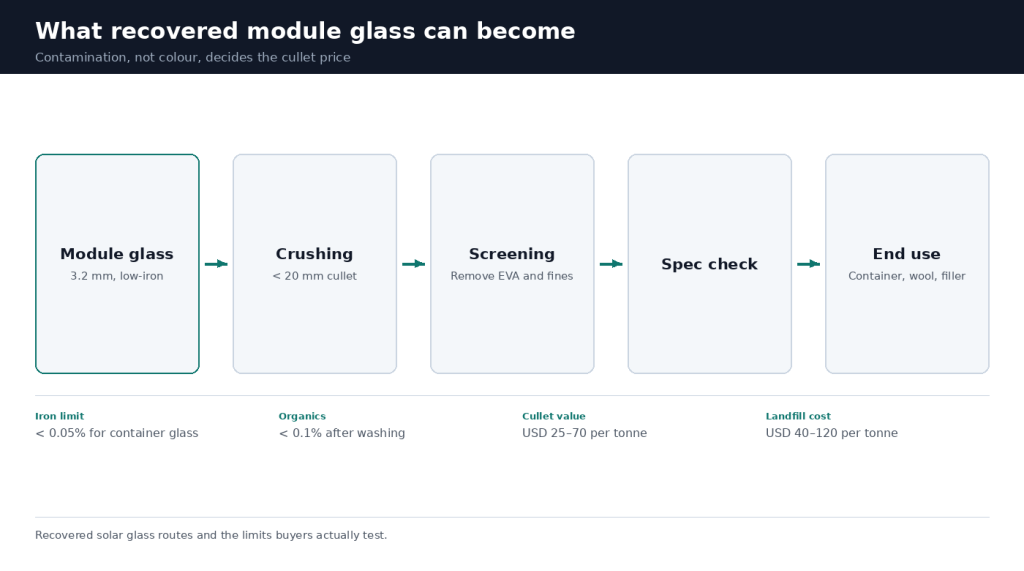
Recovered module glass is 68–72% of a photovoltaic module by mass, which makes it the largest single product of any recycling line and the one most often sold at the wrong price. The glass leaving a separator is not one material but a grade: intact 3.2 mm sheets can be re-cut for reuse, clean cullet can go to container or float furnaces, and dirty cullet goes to fibreglass, foam glass or road aggregate at a fraction of the value. The gap between those outlets is set by two contaminants, iron and antimony, and by particle size. The EU Joint Research Centre has published glass-quality thresholds for PV cullet that match what container furnaces already enforce.
What the separator actually delivers
A mechanical separator lifting sheets at 60–80 °C produces three fractions. Whole sheets, 60–85% of the glass by area on a well-set machine, come off with a thin EVA film and adhesive residue at the edges. Broken pieces above 50 mm go to cullet. Fines below 5 mm carry the EVA crumbs, the solder and the antimony-rich backsheet dust, and they ruin a cullet lot if not screened out.
Glass from a pyrolysis route is different again. It comes out carbon-free at under 0.3% but slightly hazy, with a surface that has been thermally etched, and it is almost always broken because the thermal cycle relieves the tempering stress. Tempered glass cannot be re-tempered after any thermal excursion above about 300 °C, so pyrolysis forecloses the reuse outlet and commits the glass to cullet.
Four outlets and their specifications
Container glass is the largest sink and the least demanding on iron but strict on ceramics and stones. Float and solar glass manufacturing is the most demanding and the best paid, because low-iron glass chemistry tolerates almost no colouring oxide. Fibreglass insulation accepts higher iron but punishes fines. Foam glass and aggregate take nearly anything at aggregate prices.
| Outlet | Fe₂O₃ limit | Sb limit | Size requirement | Indicative price |
|---|---|---|---|---|
| Solar / low-iron float | <0.02% | <0.01% | 2–20 mm, washed | 90–160 USD/t |
| Container glass (flint) | <0.05% | <0.03% | 10–40 mm, <2% ceramics | 55–95 USD/t |
| Container glass (green/amber) | <0.30% | <0.05% | 10–40 mm | 40–70 USD/t |
| Fibreglass insulation | <0.60% | not specified | <15 mm, low fines | 25–45 USD/t |
| Foam glass / aggregate | no limit | no limit | <30 mm | 5–20 USD/t |
The price spread between the top and bottom row is a factor of ten on the same tonnage, which is why screening and washing change a plant’s revenue more than any furnace upgrade.
Iron and antimony: the two limits that set grade
Iron in module glass arrives three ways: the low-iron float glass itself carries 0.008–0.012% Fe₂O₃ by design, the aluminium frame contributes nothing but its anodising dust does, and the EVA and backsheet carry traces. A clean separator keeps total iron at 0.03–0.06%, which clears container flint but fails solar float. That is why the solar-glass outlet is theoretical for post-consumer modules: the glass was made at 0.01% and any contamination at all pushes it over the limit.
Antimony is subtler. Antimony trioxide is used as a fining agent in some low-iron glass melts, at 0.1–0.3% in the batch, so the glass itself can carry several hundred ppm of Sb₂O₃. Container furnaces dislike it because it volatilises in the melt and deposits on the regenerator, and because it colours the glass under reducing conditions. A limit of 0.03% Sb is typical for flint container cullet, and Fraunhofer ISE reports similar figures for cullet entering European float furnaces, and a module lot that has not been screened routinely reads 0.05–0.15% because the fines concentrate the antimony-bearing dust.
The practical consequence is that screening at 5 mm and washing removes most of the antimony problem along with the dust, and that mixing two module vintages — one with antimony-fined glass, one without — creates a lot that fails on average rather than passing on average. Segregate by source, not by convenience.
What moves the cullet price
Cullet pricing is driven by the local furnace’s alternative, which is virgin sand, soda ash and limestone. When soda ash is above 300 USD/t, as it was through 2022 and 2023, every tonne of cullet substitutes roughly 1.2 t of raw batch and saves 2–3% of furnace energy, so cullet prices rise with it. When energy prices spike, cullet becomes more valuable again because melting cullet needs about 25% less energy than melting batch.
Three local factors override the commodity logic. Distance to the nearest furnace: glass cullet is a low-value, heavy material, and road freight above 300 km eats the entire margin. Colour: a flint-only furnace will pay a premium, a plant with a green furnace will not. And consistency: a container plant that runs 300 t/day cannot accept a 20 t lot one month and nothing the next, so a recycling line that cannot guarantee monthly tonnage sells at aggregate prices regardless of its chemistry.
That last point is the one most often missed. Glass buyers contract on annual tonnage with monthly call-offs, and a PV recycling line producing 400–900 t/year of cullet from a 1,000 modules per shift line is a small supplier to a furnace that consumes 100,000 t/year. The realistic outlet is a local cullet aggregator, not the furnace directly, and the aggregator’s margin is 15–25% of the price.
Qualifying a lot before you ship
Three tests decide whether a lot ships at cullet price or aggregate price. Iron by X-ray fluorescence on a fused bead, reported as Fe₂O₃, with a 0.02% resolution. Antimony by ICP after acid digestion, on the fines fraction separately as well as the bulk. And a ceramic and stone count by hand on a 10 kg sample, because one piece of refractory above 5 mm is a defect in every bottle made from that tonne.
A plant that runs these three tests weekly and keeps the certificates with the lot sells into container glass at 55–80 USD/t. A plant that ships on visual inspection alone sells at 15–25 USD/t to an aggregator who does the testing and keeps the difference.
The PV glass separator sets the ceiling on all of this, because breakage and fines are decided at that station, not downstream. MSK Machinery builds separators and complete PV module recycling lines, and the German pyrolysis reference shows the cullet grade the thermal route reaches. The manufacturer is Henan MSK Machinery Co., Ltd. of Xingyang, Zhengzhou, Henan, exporting through Sino Qtech Industries Co., Limited, with a factory since 2008, a 2019 acquisition by that Hong Kong entity, works in Xingyang and Gongyi, and ISO 9001 certification.
One more outlet deserves a mention because it is growing: PV manufacturing scrap — off-spec glass from cell and module factories — is cleaner than post-consumer glass, carries no field contamination, and frequently meets solar float specifications. It sells at 120–180 USD/t and is the one PV glass stream that can realistically return to a solar glass furnace.
FAQ
Can solar panel glass be recycled into new solar panels?
Rarely from post-consumer modules, because contamination pushes iron above the 0.02% limit that low-iron float requires. Factory scrap glass, which never left the plant, does meet that specification and is routinely returned to solar glass furnaces.
What is recovered solar glass worth per tonne?
Between 5 and 160 USD/t depending on grade: 5–20 for aggregate, 25–45 for fibreglass, 40–95 for container cullet, and 90–160 for washed low-iron cullet that meets float specifications. Freight distance above 300 km removes most of the premium.
Why is antimony a problem in glass cullet?
Antimony trioxide is a fining agent in some low-iron glass batches and volatilises in a container furnace, depositing on the regenerator and colouring the glass. Flint container cullet typically limits Sb to 0.03%, and unscreened module glass can read 0.05–0.15% because the dust concentrates it.