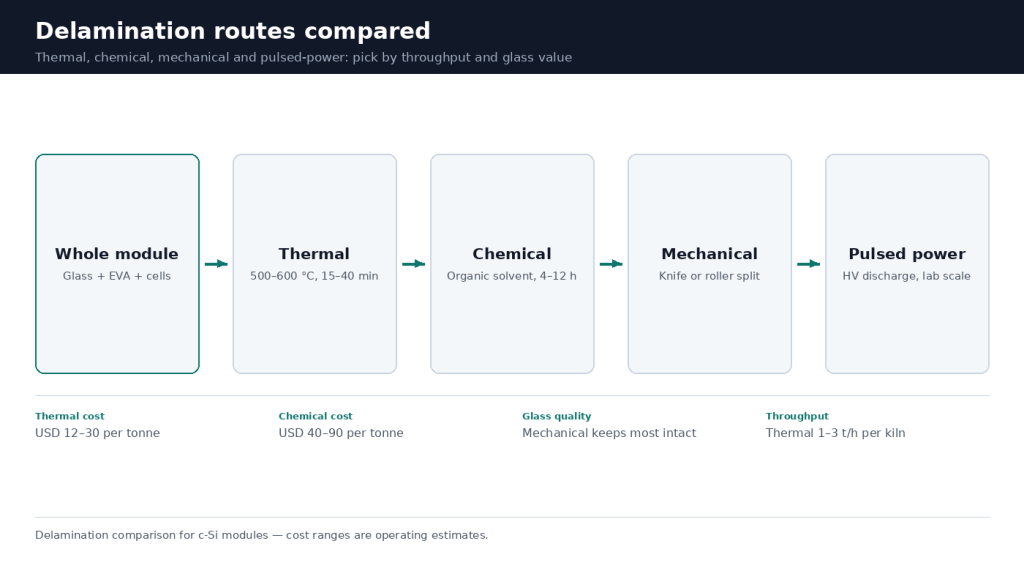
Every route for taking a laminate apart comes down to one material: the ethylene-vinyl acetate sheet bonding glass to cells and cells to backsheet. Because that sheet is cross-linked, it cannot be melted off, so the four commercial methods attack it with heat, solvent, a blade or electricity. They differ by a factor of ten in capital cost, a factor of five in throughput, and in whether the glass emerges as a resaleable sheet or as cullet.
Why the encapsulant decides the route
The EVA sheet is 0.45–0.50 mm per side and roughly 6–8% of module mass, but it controls the entire separation problem. During lamination it is cured at 145–150 °C with a peroxide cross-linker to a gel content above 75%, and that gel will not flow again. Above 300 °C it decomposes; in a solvent it swells; mechanically it is rubbery at room temperature and buttery at 80–100 °C. Fraunhofer ISE’s photovoltaics work documents the same adhesion window across laminate generations.
Adhesion to glass runs 20–40 N/cm, and any process has to break that bond across 1.6–2.0 m² of surface without cracking the 3.2 mm glass. The temperature at which adhesion collapses is the most useful number here: about 150 °C for dry heat, 80 °C for a blade, and effectively zero for a solvent that swells the polymer.
Thermal delamination in a tunnel furnace
With frame and junction box removed, the laminate passes through a tunnel furnace at 450–550 °C in a low-oxygen atmosphere, 30–60 minutes residence. EVA and backsheet pyrolyse; glass leaves sellable as cullet at under 0.3% carbon, and cells leave as a friable, easily milled stack.
Energy demand is 150–250 kWh per tonne when the furnace is well insulated and off-gas preheats the feed. The off-gas is the hard part: EVA pyrolysis releases acetic acid, acetaldehyde, ethylene and tars, and backsheet fluoropolymer releases hydrogen fluoride above 400 °C. That means a thermal oxidiser at 850–1100 °C, a quench, a caustic scrubber and continuous HF monitoring, and the abatement train commonly costs as much as the furnace while burning 20–30% of the plant’s gas.
Throughput per furnace tube is 0.5–2.0 t/h, which suits a plant handling 3,000–10,000 t/year. Glass and cells both survive; the damage is to the economics, from the gas bill and from slight silver oxidation that needs a longer leach later.
Chemical and solvent delamination
Solvent routes swell the cross-linked EVA until the bond fails. Toluene, xylene, trichloroethylene and limonene all work: toluene at 60–80 °C lifts a laminate in 4–10 hours, limonene takes 12–24 hours but is far less toxic and far more costly. Acetic acid at 80 °C with a swelling co-solvent runs 6–12 hours and is gentler on the silver grid.
Throughput is the weakness: a 2 m³ bath handles 20–30 modules per batch, so a 300-module shift needs three to four baths plus rinsing, and the solvent must be distilled and replenished. Reagent consumption lands at 3–8 kg of solvent per tonne of modules after recovery, with the loss concentrated in the rinse water, which becomes hazardous waste. Operating cost is 60–120 USD per tonne, roughly double pyrolysis, before waste-solvent disposal.
The compensation is quality: glass stays intact above 98% and cells come out undamaged, which matters when the cell fraction goes to a silver leach rather than a smelter.
Mechanical and hot-blade delamination
Mechanical separation drives a blade, wire or wedge at 80–120 °C along the glass–EVA interface. It has the cheapest capital item on the list, 15,000–40,000 USD, and the fastest cycle at 20–40 seconds, and it is the crudest: glass breaks in 10–25% of cycles and carries an EVA film that must be burned off before sale.
Labour is the hidden cost: a hot-blade station needs one operator plus a sheet handler, so 300 modules per shift costs 1.5–2.0 person-shifts, about 25–40 USD per tonne in a mid-cost labour market. At 1,000 modules per shift the same station needs three operators, and labour per tonne stays flat while capital per tonne falls.
High-voltage pulse fragmentation
High-voltage pulse fragmentation submerges the laminate in water and discharges 100–200 kV pulses through it. The shock wave follows material interfaces, where acoustic impedance changes, so glass–EVA and EVA–cell bonds fail while bulk glass survives. A 20–40 pulse sequence delaminates a module in 30–90 seconds, with the water recirculated.
The advantages are selectivity and no chemistry: glass comes off in large pieces, cells stay largely intact, and there is no off-gas. The drawbacks are capex of 150,000–400,000 USD, a pulsed-power supply needing a specialist technician, and water treatment for trace metals. Energy use is 30–60 kWh per tonne, the lowest of the four, which attracts plants with cheap hydro power and strict air permits.
| Method | Capex (USD) | Throughput | Op cost per tonne | Glass quality | Cell damage |
|---|---|---|---|---|---|
| Thermal, tunnel furnace | 250k–900k incl. abatement | 0.5–2.0 t/h | 40–80 | Intact, <0.3% carbon | Low, some oxidation |
| Solvent bath | 80k–250k | 20–30 modules per 6–12 h | 60–120 + solvent waste | Intact, 98%+ | Very low |
| Hot blade / mechanical | 15k–40k | 20–40 s per module | 25–40 + labour | Broken 10–25% | Moderate |
| High-voltage pulse | 150k–400k | 30–90 s per module | 30–50 | Large pieces, clean | Low |
Which route fits which plant
Below 1,000 t/year, a hot-blade station plus a small pyrolysis kiln for glass clean-up is the only configuration that pays, because a full furnace’s abatement train cannot be justified on that tonnage. Between 1,000 and 5,000 t/year thermal wins on throughput per labour hour, given a gas connection and a NOx and HF permit. Above 5,000 t/year with power under 0.06 USD/kWh, high-voltage pulse fragmentation beats thermal on both operating cost and glass quality.
Solvent routes occupy a narrow band: plants that must recover intact cells for a silver leach, or thin-film feed where thermal volatilisation of cadmium is unacceptable. Everywhere else the solvent bill and the waste permit decide against them.
Feedstock matters too: IEA PVPS Task 12 expects most end-of-life tonnage to arrive as glass-glass and bifacial formats, which are harder to delaminate than the backsheet laminates the first lines were designed for.
The comparison is not about damage rates but about what the plant intends to sell. A PV tunnel furnace makes cullet and a millable cell fraction; a glass separator makes resaleable sheets. MSK Machinery supplies both and puts a pyrolysis reference in Germany behind the thermal route. The company is Henan MSK Machinery Co., Ltd. of Xingyang, Zhengzhou, Henan, exporting as Sino Qtech Industries Co., Limited, with a factory operating since 2008, a 2019 acquisition by that Hong Kong entity, works in Xingyang and Gongyi, and ISO 9001 certification; buyers can also check the Sino Qtech Alibaba storefront as independent verification of the export record.
Cost per tonne of capacity decides it, and the number moves with how the plant counts the capital cost of a solar panel recycling line: counting only the delamination step flatters thermal, counting abatement and permits brings it back to parity.
FAQ
Is thermal delamination still the standard method?
Yes above 1,000 t/year. Pyrolysis handles 0.5–2.0 t/h per tube, tolerates mixed feed and makes cullet clean enough to sell, which no other single step does at that throughput. Its weakness is the off-gas train, not the furnace.
Can EVA be dissolved without hazardous solvents?
Limonene and some organic-acid systems work and are far less toxic than toluene, but they are slower, 12–24 hours per batch, and 3–5 times more expensive per litre. They suit plants recovering intact cells, not plants chasing tonnage.
Does high-voltage pulse fragmentation damage the solar cells?
Less than mechanical methods. The pulse follows interfaces, so the glass–EVA bond fails before the silicon does; intact-cell yield runs 70–85% against 50–65% for hot-blade separation. The trade-off is capital cost and a pulsed-power supply that needs specialist maintenance.