A decoating kiln receives cans that are about 95% aluminium and 5% material that is not aluminium: lacquer, printing ink, dried beverage, salt and water. The aluminium leaves as furnace-ready flake; everything else burns, condenses on a cold surface, or attacks the refractory. Most faults operators blame on the kiln are really feed-quality or off-gas design faults.
What is actually on a used can
A beverage can has an interior lacquer of 2–4 g/m², an exterior base coat, printed ink and a clear varnish. Together these organics are 3–5% of the can by weight, so a 14 g can carries 0.4–0.7 g of coating. Unrinsed cans add 1–4% residual drink — mostly water with sugar and phosphoric or citric acid — and cans from roadside or coastal collections carry sodium chloride. Paint must be cracked and oxidised, sugar caramelises before it burns, and salt never leaves the gas phase cleanly.
Salt does not burn
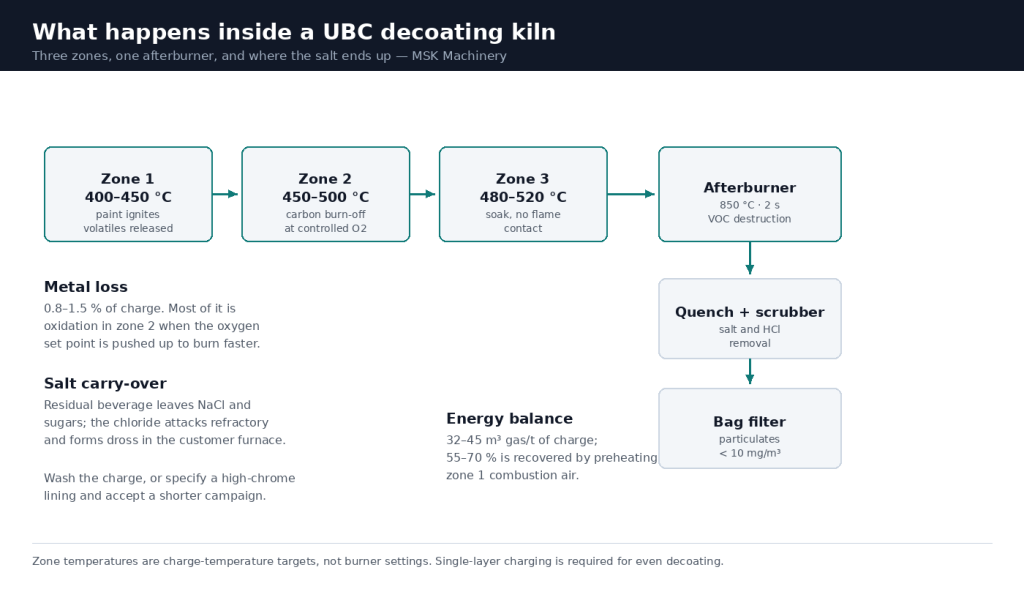
Sodium chloride melts at 801 °C, so at 480–520 °C it stays solid. Fine crystals are elutriated from the drum, carried with the off-gas and deposited on cooler surfaces. With moisture and sulphur oxides present, alkali chlorides convert to hydrogen chloride and sodium sulphate; the HCl loads the scrubber, and the sulphate forms a hard bonded deposit.
Chloride also lowers the melting point of the ash landing on refractory. A mixed alkali-chloride deposit can become liquid at 600–700 °C, inside the hot-face range. The liquid penetrates open porosity, crystallises on cooling and spalls the lining from behind. Salty feed therefore needs dense, low-porosity refractories and a defined cleaning interval, not just a higher alumina grade.
Salt on the flake enters the smelter, forms chloride-rich dross and adds to the salt-cake stream.
Paint burns in two stages, and the first one is the problem
Between roughly 250 and 350 °C the lacquer softens before it decomposes. In that window it is sticky, and sticky flake blinds the internal flights, bridges in the drum and builds a ring near the discharge. Above 350 °C pyrolysis takes over: the polymer cracks to char and condensable tar, and the char burns slowly because it sits tight against the metal.
Residence time is therefore set by char burn-out, not by paint ignition. A kiln at 500 °C with 15–25 minutes of solids residence finishes the job; the same kiln at 430 °C, run faster to save gas, discharges flake that is still black on one face. Those flakes pass a grab sample but cost the smelter in dross. Raising the temperature trades a smear problem for an oxidation problem, which is why the window is held at 480–520 °C and throughput is adjusted instead.
What each contaminant does in the kiln
| Contaminant | Typical load | Behaviour at 480–520 °C | Where it ends up | If it is ignored |
|---|---|---|---|---|
| Lacquer and ink | 3–5 wt% | Softens at 250–350 °C, pyrolyses above 350 °C | Afterburner; char on flake | Smear, ring build-up, incomplete decoat |
| Sugar and drink residue | 1–4 wt% | Caramelises, then burns slowly | Flights, duct, filter | Agglomeration, hot spots, blocked flights |
| Sodium chloride | 0.02–0.3 wt% | Solid; fine fraction elutriates | Refractory, afterburner, scrubber | HCl, refractory fluxing, dross |
| Moisture | 1–3 wt% | Steam; latent heat load | Stack | Energy penalty, acid formation, wet feed |
| Oil, grease, plastic tramp | 0.1–1 wt% | Burns with a long, hot flame | Kiln, bag filter | Local overheating, filter fire |
Dross and metal loss
A decoater runs below the 660 °C melting point of aluminium, so there is no melt loss in the drum. Surface oxidation still occurs: a clean seal and low-oxygen atmosphere hold it at 1–2%, while air ingress through the feed and discharge ends can push it to 3–5%. On a 4 t/h line that is 40–120 kg of metal a day.
In the smelter, coating burned in the melt consumes oxygen at the bath surface, generates dross and carries metal out; removing it upstream moves that loss somewhere controllable.
Refractory attack and what to specify
Three mechanisms act together: alkali-chloride fluxing of the hot face, thermal cycling from stops and starts, and abrasion from tumbling flake. A 60–70% alumina low-cement castable with low open porosity handles the first and third. Silica-rich insulation behind it does not: once chloride-impregnated insulation sinters, it becomes a thermal bridge. Expansion joints must be sized for the shell, and the discharge box needs a clean-out door operators will actually use.
Shell thermocouples at three points along the drum are worth more than a single bed probe. A rising shell temperature at constant burner output means refractory wear, and catching it early is the difference between a reline and a shell repair.
Off-gas design decides the permit
The off-gas carries CO, VOC, tar, HCl, dust and alkali fumes. The standard train is cyclone, afterburner, heat recovery, rapid quench, scrubber and bag filter. The afterburner must hold 850–1,100 °C for at least two seconds at the peak organic load, which arrives with a wet or heavily coated batch, not at the daily average.
Two details are routinely missed. Dioxin formation is catalysed by copper and chloride between 250 and 450 °C, so the gas must cross that window quickly and the bag filter must run below about 200 °C. And tar condenses at 120–180 °C, so a horizontal duct without slope or trace heating slowly fills with tar and restricts the fan.
The UBC decoating route sets out the full sequence, and the UBC rotary decoater page gives the drum and afterburner specification. Throughput options are compared on the 2 t/h UBC line and the 3 t/h coated aluminium line.
What operators get wrong
- Feeding wet cans. Water consumes heat, makes steam, promotes HCl and turns the feed sticky. A dryer is cheaper than a bigger burner.
- Overloading the drum. Residence time collapses before the temperature reading moves, so the kiln reports 500 °C while the flake is half done.
- Skipping the afterburner at start-up. Start-up combines the highest organic load with the coldest stack.
- Cleaning only at shutdown. Salt and ash build-up is progressive; a monthly look at the discharge ring prevents most unscheduled stops.
Decoating versus melting coated scrap directly is a cost comparison rather than a principle, and the numbers sit in decoating versus direct melting.
Why the feed assay matters more than the brochure
Two bales of UBC from different collection systems can differ threefold in salt and moisture. The USGS aluminium summary and the EU JRC Raw Materials Information System document the scale of the stream and its recovery losses, but neither replaces a moisture and chloride analysis of your own bales.
MSK Machinery designs and commissions these kilns through Henan MSK Machinery Co., Ltd. at Xingyang, Zhengzhou, Henan, with export contracts handled by Sino Qtech Industries Co., Limited. The sizing basis is the coating load, chloride level and intended running hours.
FAQ
Does decoating remove salt from used beverage cans?
Only partly. Salt stays solid at 480–520 °C, so it does not burn off; some fine crystals leave with the off-gas and are captured in the scrubber, but most leave with the flake or deposit on the refractory.
Why does my decoated flake still look black?
Residence time, not temperature, is the usual cause. Char burns slowly against the metal surface, so a drum run above its rated throughput discharges flake with unburnt lacquer even when the thermocouple reads correctly.
Can a decoater run on natural gas, LPG or producer gas?
Yes. The burner is selected for the available fuel, and the afterburner and heat-recovery train are sized on its calorific value. Producer gas needs a larger volumetric flow and a different control valve.