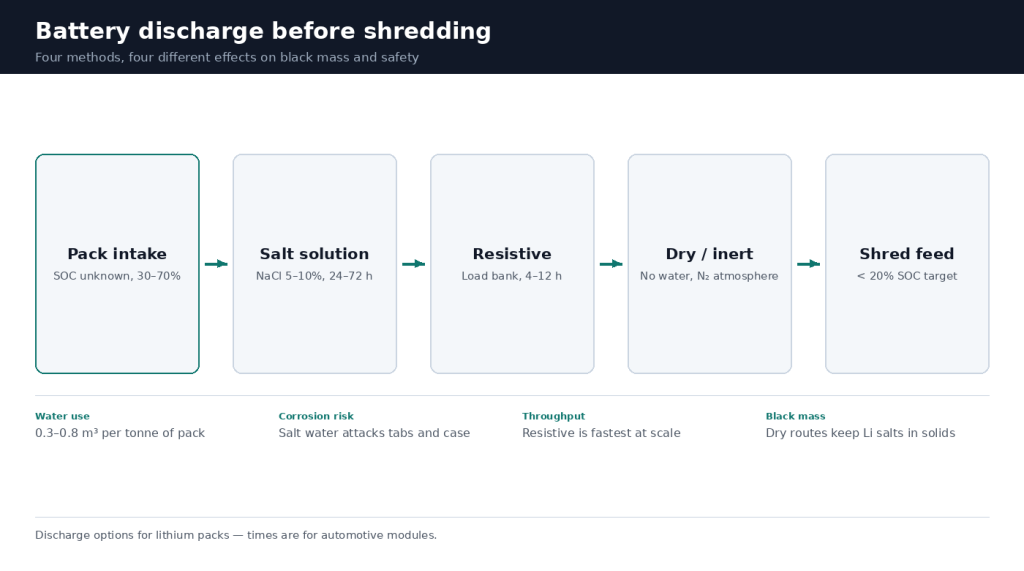
A lithium-ion pack arriving at a recycling plant at 50% state of charge is a fire waiting for a reason. Discharging it before shredding is therefore the first process step, not a housekeeping detail, and the four methods in commercial use differ by three orders of magnitude in time, from minutes to days, in whether they produce any liquid effluent at all, and in whether the black mass they leave behind still fetches cathode-grade prices.
Why discharge is the first process step
Shredding a charged cell releases the stored energy into the cutting zone. A 60 kWh pack at 50% state of charge holds 30 kWh, which in a shredder appears as sparks, local heating, cell rupture and the release of electrolyte vapour that ignites above 40 °C in air. The practical rule is that no cell above 1.0 V per cell enters a shredder, and most operators target below 0.5 V to be safe.
There is also a materials argument. A discharged cell is chemically calmer: lithiated graphite is less reactive with air and water, the electrolyte is less likely to vent hydrogen fluoride, and the cathode oxides are less thermally unstable, which makes the downstream line cheaper to permit and insure.
Salt-solution discharge
The traditional method immerses packs or modules in a 5–10% sodium chloride solution. The brine conducts between terminals, and the pack self-discharges at a rate set by its own internal resistance and the conductivity of the bath. A pack reaches below 1 V per cell in 24–48 hours, large modules in 48–72 hours.
It is cheap, needs no power supply and works on any format, but it carries the worst hidden costs. Water consumption is 3–10 litres per kg of battery, and the water becomes a lithium-, fluoride- and nickel-bearing effluent that needs treatment. Corrosion of the aluminium case produces hydrogen, so the tank needs ventilation and gas detection.
Lithium losses to the bath are real: 100–500 mg/L of lithium accumulates in a working bath within weeks, which is lithium that never reaches the black mass. For a plant paid on cathode metal recovery, that is a direct revenue leak.
Resistive discharge with energy recovery
A resistive discharge connects the pack to a load bank through a controlled contactor, drawing current until the terminal voltage falls to a set point. A 50 kWh pack discharges in 4–12 hours at a 5 kW load, and the energy can be recovered into the plant’s own supply or into a storage buffer at 50–70% efficiency.
The advantage is control: current is regulated, module voltages are logged, and the process stops at the target voltage rather than when the brine finishes the job. The disadvantage is that it needs a live, communicating BMS, so packs with a dead BMS, a welded lid or a swollen cell cannot be discharged this way.
Thermal risk is concentrated at the end. A pack discharged below 2.0 V per cell can reverse the polarity of the weakest cell, and a reversed cell heats. Load banks therefore cut off at 2.5 V per cell for packs that will be dismantled, and at 1.5 V for packs going straight to shredding, with a per-module voltage check before the load is removed.
Cryogenic and dry routes
Cryogenic discharge immerses the pack in liquid nitrogen at −196 °C. The electrolyte freezes, ion mobility collapses, and residual energy becomes inaccessible within 5–15 minutes. Nitrogen consumption of 1.5–3 kg per kg of battery, at 0.15–0.30 USD/kg, dominates the cost, but the method is fast, effluent-free and passivates the cell well enough for immediate shredding.
Dry discharge covers a family of methods that avoid water entirely: discharging in a sealed chamber under nitrogen with a resistive load, external shorting through a diode bank, or controlled self-discharge in an inert atmosphere over 5–10 days. Energy use is 20–60 kWh per tonne, water use is zero, and the absence of effluent is decisive where the plant has no wastewater treatment and no discharge permit.
| Method | Time to <1 V/cell | Water | Energy | Main safety issue | Effect on black mass |
|---|---|---|---|---|---|
| Salt solution | 24–72 h | 3–10 L/kg | none | H₂ from can corrosion | Li and F leach to effluent, 2–5% Li loss |
| Resistive + recovery | 4–12 h per pack | none | recovers 50–70% | Cell reversal at low voltage | Neutral, Li stays in cell |
| Cryogenic (LN₂) | 5–15 min | none | 1.5–3 kg LN₂/kg | Asphyxiation, cold burns | Neutral, electrolyte frozen in place |
| Dry / inert chamber | 5–10 days | none | 20–60 kWh/t | Slow, needs large buffer | Neutral |
The over-discharge trap
Discharge protects the shredder but can damage the product. Below about 1.0–1.5 V per cell, the copper current collector at the anode begins to dissolve into the electrolyte, and on subsequent charging or on contact with the cathode it plates back as metallic copper dispersed through the electrode stack. In a recycling line there is no charging step, so the copper simply reports to the black mass as fine metallic contamination.
The effect on value is measurable. Cathode black mass sold to a hydrometallurgical refiner is priced on nickel, cobalt and lithium content with penalties for copper and aluminium, and a copper penalty typically starts at 1% and becomes severe above 3%. A pack over-discharged to 0.2 V per cell can push black mass copper from 0.5% to 2.5–4%, which cuts the payable value by 8–15%.
So the discharge target is a compromise, and it depends on the downstream route. For a mechanical line producing black mass for hydrometallurgy, stop at 1.5–2.0 V per cell. For a line that shreds under nitrogen and sends the whole fraction to a smelter, 0.5 V is fine because the smelter pays for copper. The mistake is applying one set point across both.
Choosing a method
Salt solution survives where labour is cheap, volumes are small and a wastewater permit exists. Resistive discharge wins wherever packs arrive with a live BMS and the plant can use the recovered energy, which covers most automotive and stationary storage feed. Cryogenic suits damaged or swollen packs that cannot be connected. Dry chamber discharge is the emerging default for new lines, because it needs no effluent permit and shares the nitrogen blanket the shredder needs anyway.
A battery discharge rack with per-channel voltage logging is the minimum instrumentation, because discharge without cell-level data is guesswork. The 1 t/h lithium battery sorting line pairs that rack with sorting and black mass production; MSK Machinery builds both, with a reference installation in Vietnam. The manufacturer is Henan MSK Machinery Co., Ltd. of Xingyang, Zhengzhou, Henan, exporting as Sino Qtech Industries Co., Limited, with a factory since 2008, a 2019 acquisition by that Hong Kong entity, works in Xingyang and Gongyi, and ISO 9001 certification; the Sino Qtech Alibaba storefront is available as independent verification.
Battery chemistry background and recycling process data are collected by the US Department of Energy’s vehicle battery programme, and the World Bank’s energy practice tracks the storage build-out that will feed these lines.
FAQ
How long does it take to discharge a lithium battery for recycling?
Five to fifteen minutes in liquid nitrogen, 4–12 hours on a resistive load bank, 24–72 hours in salt solution, and 5–10 days in a dry inert chamber. The right target is 1.5–2.0 V per cell for hydrometallurgical black mass and 0.5 V for smelter feed.
Is salt water discharge bad for black mass value?
It costs 2–5% of the lithium, which leaches into the bath at 100–500 mg/L, and it destroys aluminium casings through corrosion. The cathode metals stay in the cell, so nickel and cobalt recovery is unaffected; the loss is lithium and the effluent treatment bill.
Can a swollen or damaged pack be discharged resistively?
No. A pack with a dead BMS, welded lid or visibly swollen cell cannot be connected safely; it goes to cryogenic passivation or into a nitrogen-blanketed shredder at reduced charge size.