Every aluminium melt produces dross, and every salt-fluxed melt produces salt slag. The two are related but not the same problem: dross is a metal-rich by-product you can press and sell, salt slag is a hazardous waste that has to be processed under an environmental permit. A plant’s dross rate is a direct readout of how well it is running, and its salt slag volume is a direct readout of how much salt it chose to use instead of fixing the furnace.
How much dross a furnace makes
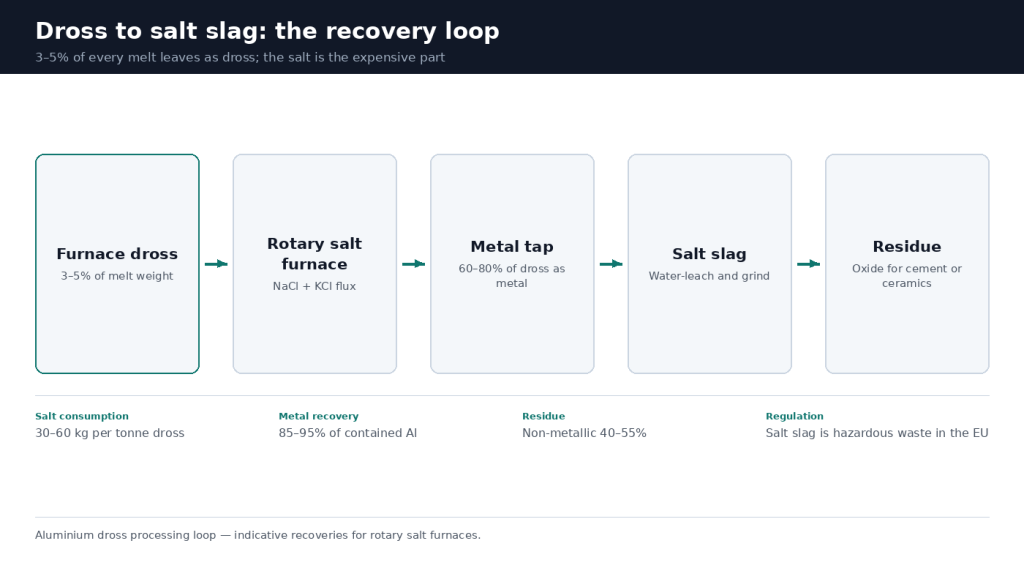
Dross generation is quoted as a percentage of metal charged. A clean, heavy scrap melted under a protective cover in a well-sealed furnace produces 1.0–2.0%. Shredded coated scrap without decoating produces 4–8%. UBC shredded and charged top-wise into an open-door rotary furnace produces 6–10%, and the dross from that operation is finer, blacker and lower in recoverable metal than dross from clean charge.
The rate is not a property of the metal; it is a property of the process. Surface area, oxygen at the door, bath temperature, flux coverage and residence time all move it, and the operators who report 2% dross on coated scrap are almost always running a submerged charge into a sealed furnace with a salt cover. The ones reporting 9% are running an open door and blaming the scrap.
Two routes: salt rotary and salt-free
The salt rotary furnace is the traditional answer. Scrap and a NaCl-KCl flux with 3–5% cryolite and 2–4% fluorspar go into a rotating barrel at 750–800 °C. The salt melts, wets the oxide and floats it away from the metal, the aluminium pools at the bottom and is tapped, and the salt plus oxide is raked out as salt slag. Salt consumption runs 2–5% of the charge for coated scrap, or 200–500 kg per tonne of dross produced.
Salt-free routes — a sealed reverb with a salt-free flux, or a tilting rotary with an inert atmosphere — produce dross with no salt, which can be pressed for metal and then sold as a oxide-rich residue. They avoid salt slag entirely but demand better feed preparation and tighter furnace control. On decoated UBC, a salt-free reverb reaches 1–2% dross and sidesteps the whole hazardous-waste chain, which is why decoating and salt-free melting are usually specified together.
What salt slag contains
Salt slag is roughly 30–55% NaCl-KCl, 20–40% aluminium oxide, 5–15% spinel and magnesium oxide, 3–8% metallic aluminium droplets, and 1–3% aluminium nitride, aluminium carbide and sulphides. That last group is what makes it hazardous: aluminium nitride hydrolyses on contact with water to aluminium hydroxide and ammonia, aluminium carbide to methane, and any entrained metal generates hydrogen. A pile of salt slag left in the rain will smell of ammonia and can heat spontaneously.
| Dross or slag type | Metallic Al | Salt content | Hazard status | Normal route |
|---|---|---|---|---|
| Clean reverb dross | 50–70% | none | Non-hazardous in most jurisdictions | Cool, crush, screen, sell metal |
| Coated scrap dross | 35–55% | none | Reactive, needs dry storage | Press, then oxide sale |
| Salt rotary dross, coarse | 40–60% | 10–25% | Hazardous | Salt slag processing |
| Salt slag from rotary | 3–8% | 30–55% | Hazardous, EU waste code 10 03 08 | Salt and oxide recovery |
| Salt slag fines, <2 mm | 8–15% | 40–60% | Hazardous, ammonia-generating | Wet grinding, salt wash |
Recovering salt, metal and oxide
Salt slag processing is a wet or dry liberation circuit. The slag is crushed to below 20 mm, then ground in a ball or rod mill, either dry or in a brine slurry. Salt dissolves, the oxide reports to a fines stream, and the metal droplets report to a coarse stream that is screened and sold as a 70–85% aluminium concentrate. The brine is filtered, evaporated and crystallised, and the recovered salt returns to the furnace at 90–95% recovery.
A well-run plant recovers 90–95% of the salt, 60–80% of the metallic aluminium, and 80–90% of the oxide. The oxide residue, sometimes called salt slag oxide or black oxide, goes to cement kilns as an alumina source, to refractory manufacture, or to mineral wool. Its value is low, 20–60 USD/t, and its disposal cost is what drives the economics: in Europe, landfill of salt slag is effectively closed, so the processor’s gate fee, 60–150 USD/t of slag, is the revenue line that matters.
Throughput is modest. A 1 t/h slag plant handles the output of a furnace melting 20–40 t/day of coated scrap, so the processing unit is small relative to the melting operation but cannot be skipped, because the slag accumulates faster than it can be shipped.
Environmental rules that decide the plant
In the European Union, salt slag is listed as hazardous waste under entry 10 03 08 of the List of Wastes, which means permitted transfer, licensed carriers, and a treatment route that must itself be permitted. Several member states ban landfill outright. The practical effect is that any EU aluminium plant using salt flux must have a contracted slag processor, and the contract terms, not the melting cost, decide whether salt flux is viable.
Elsewhere the rules vary widely but converge on three points: salt slag cannot go to ordinary landfill because of its ammonia and hydrogen generation, storage must be dry and covered, and the processor must hold an air permit for the ammonia and particulate emissions from grinding. China, India and the Gulf states all regulate salt slag as a hazardous or special waste, and permit conditions typically require recovery rather than disposal.
Dross is a different case. Pressed dross with low salt is sold as a commodity, priced at a discount to aluminium based on its metallic content, typically 55–75% of the metal price for 50% metallic dross. Unpressed dross sold wet is priced at 30–45%, because the buyer carries the oxidation risk.
The cleanest way to keep dross and slag volumes down is upstream, and that is why decoating before melting changes the waste balance as much as the metal yield. A 2 t/h decoating line feeding a salt-free reverb produces 25–50 kg of dross per tonne and no salt slag at all. MSK Machinery builds the decoating kilns and UBC decoating lines that make that configuration possible; the manufacturer is Henan MSK Machinery Co., Ltd. of Xingyang, Zhengzhou, Henan, exporting as Sino Qtech Industries Co., Limited, with a factory since 2008, a 2019 acquisition by that Hong Kong entity, works in Xingyang and Gongyi, and ISO 9001 certification.
The USGS aluminium summary and the EU Joint Research Centre both track secondary aluminium flows and the waste streams attached to them, and both make the same point: recovery rates for dross and salt slag are a function of regulation and gate fees far more than of technology.
FAQ
How much dross does an aluminium furnace produce per tonne?
1–2% of charge on clean, heavy scrap in a sealed furnace, 4–8% on shredded coated scrap, and 6–10% on whole cans top-charged into an open rotary furnace. The variable that moves it most is oxygen at the charge door, not the scrap itself.
Is salt slag hazardous waste?
Yes in the EU, under waste code 10 03 08, and effectively so in most other jurisdictions. It generates ammonia and methane when wet, can heat spontaneously, and must go to a permitted recovery plant that reclaims the salt, the metal and the oxide.
Can salt slag be avoided entirely?
Yes, by decoating the scrap and melting in a sealed salt-free furnace. That route produces no salt slag, 25–50 kg of dross per tonne, and needs no cryolite or fluorspar, at the cost of the kiln’s fuel and the tighter furnace control it demands.