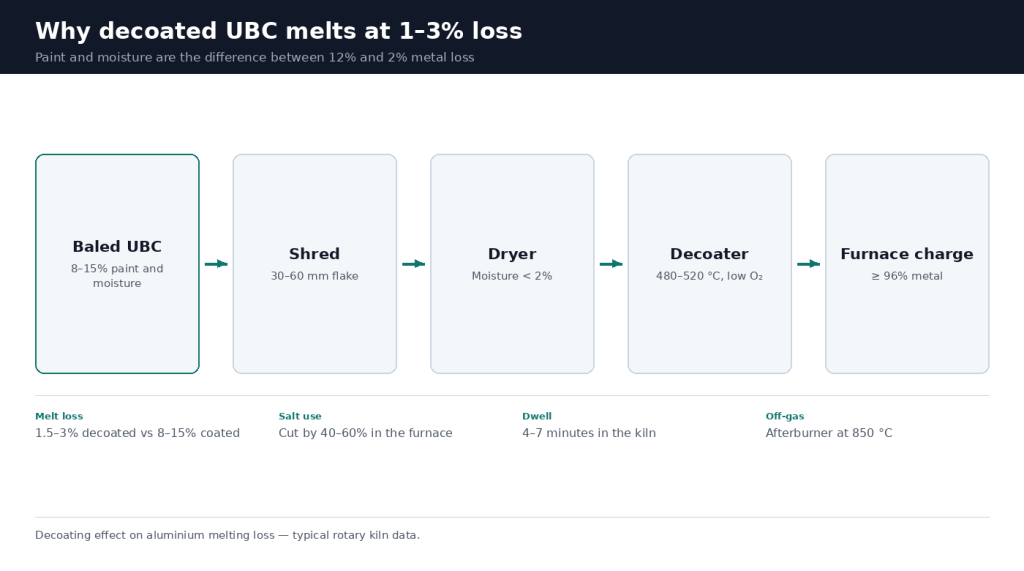
Used beverage cans shredded and charged straight into a rotary furnace lose 8–15% of their aluminium before the metal is tapped. The same cans, decoated in a kiln to under 2% residual organics, lose 1–3%. That difference is not a claim about equipment quality; it is the arithmetic of thin-gauge aluminium exposed to an oxidising atmosphere at 750 °C. On 20,000 t/year of UBC at an aluminium price of 2,400 USD/t, the gap between 12% and 2% loss is 4.8 million USD of metal a year.
Where the 8–15% goes
Melt loss is aluminium that leaves the furnace as oxide rather than as ingot. The reaction is 4Al + 3O₂ → 2Al₂O₃, and the mass ratio is brutal: every kilogram of oxide scale formed consumes 0.53 kg of metal and reports to dross. A can body wall is 0.10–0.12 mm thick, so a tonne of shredded UBC presents 20,000–30,000 m² of surface once cut to 20–30 mm pieces. There is no other aluminium scrap stream with that surface-to-mass ratio except foil.
Three mechanisms act together. Direct oxidation builds a scale layer that melt circulation removes, exposing fresh metal, so the loss is not self-limiting. Organics — internal lacquer, external print, residual beer — burn in contact with the metal and create 900–1,000 °C hotspots on a 0.1 mm wall, where oxidation runs several times faster than in the bulk bath. And moisture dissociates in the melt, generating hydrogen that increases porosity and stirs oxide into the metal.
Why coated scrap burns metal
A UBC carries 3–5% of its weight as organic coating: a 3–6 µm internal epoxy lacquer, a 4–8 µm external base coat, and printing inks. Burning that coating requires 15–25 m³ of air per tonne of scrap and releases 2,500–4,000 MJ. In a rotary furnace that heat is released right where you do not want it, at the metal surface, and the burner has to add more heat on top because the furnace is trying to hold a bath at 730–760 °C while a thin wall in front of it is at 950 °C.
Coated scrap also carries the can’s moisture and the shredder’s fines. Fines below 5 mm are the worst fraction: they oxidise almost completely in the flame and end up in the dross rather than the bath. A shredder that produces 8–12% fines by weight is handing 8–12% of the charge to the dross bin before the furnace has done anything.
Salt flux masks some of this. A NaCl-KCl mix with 3–5% cryolite over the bath limits air access and dissolves the oxide film, which is why salt furnaces report lower loss on the same feed. It does not fix the mechanism, it slows it, and it converts the problem into salt slag.
What decoating removes
A decoating kiln drives off the coating before the metal reaches a melting furnace. The three zones are standard: drying at 200–300 °C, volatilisation at 350–450 °C where the lacquer depolymerises, and burnout at 450–550 °C where carbon oxidises to below 1–2%. Residence is 20–40 minutes depending on load depth, and the zones run slightly negative so volatiles go to the afterburner rather than out of the shell.
The critical control is oxygen in the burnout zone. Too much oxygen and the kiln becomes an oxidation reactor for the aluminium itself; too little and the carbon does not burn off. The practical window is 4–8% O₂ at the discharge end, with the metal temperature held under 560 °C, well below the 660 °C melting point, so that no liquid phase forms and the oxide film stays intact and protective.
Energy demand is 250–400 kWh per tonne of product, or 25–40 m³ of natural gas, which is the main operating cost. Against that, decoated UBC charges into the furnace at 1–3% loss, needs no salt flux, produces 40–60% less dross, and the afterburner destroys the volatiles at 850 °C so the kiln meets the same emission limits as the furnace.
| Feed preparation | Melt loss | Dross kg/t | Salt needed | Recovery from dross |
|---|---|---|---|---|
| Whole cans, top charged | 12–15% | 180–260 | Yes, 2–4% | 35–50% of dross mass |
| Shredded UBC, 20–30 mm | 8–12% | 140–200 | Yes, 2–3% | 40–55% |
| Shredded and dedusted | 6–9% | 110–160 | Optional | 45–60% |
| Decoated, <2% organics | 1.5–3.0% | 40–70 | No | 55–65% |
| Decoated, briquetted | 1.0–2.0% | 25–50 | No | 60–70% |
The furnace conditions that decide the rest
Decoating removes the organics but cannot remove the physics. Four furnace variables decide whether a decoated charge runs at 1% or 4% loss. Bath temperature is the first: oxidation rate roughly doubles for every 50 °C above 720 °C, so a furnace run at 780 °C to chase throughput loses twice the metal of one held at 730 °C.
Atmosphere is the second. Stack oxygen above 4% at the charge door means the furnace is pulling air across the bath; a sealed shell with a controlled bleed and a CO monitor holds it at 1–3%. Charge method is the third: submerging the scrap under the bath surface with a mechanical charger or a vortex pump cuts contact with air by an order of magnitude compared with top charging, where cans sit on the surface inside the flame. Residence time is the fourth, and it is the one operators violate most often, because holding metal at temperature for an extra 20 minutes to smooth the tap schedule costs 0.3–0.5% of the charge in oxidation.
Dross handling completes the balance. Dross tapped at 700 °C still holds 45–65% metallic aluminium, and if it cools slowly in air that metal oxidises inside the dross and releases heat that burns more of it. Pressing within 15 minutes recovers the metal as a saleable ingot and leaves a residue at 20–30% metallic.
The economics follow once the loss rate is known. A 2 t/h UBC decoating line burns 25–40 m³ of gas per tonne and returns 6–9 points of metal yield, which at 2,400 USD/t pays back in under a year. Decoating versus direct melting is a choice between paying for gas and paying for lost metal.
Nothing here is specific to beverage cans: painted profile, closures and litho sheet behave the same way, and a UBC decoater sized for can scrap runs coated aluminium with a residence-time adjustment. MSK Machinery builds the kilns and the UBC decoating systems around them; the manufacturer is Henan MSK Machinery Co., Ltd. of Xingyang, Zhengzhou, Henan, exporting as Sino Qtech Industries Co., Limited, with a factory since 2008, a 2019 acquisition by that Hong Kong entity, works in Xingyang and Gongyi, and ISO 9001 certification; the Sino Qtech Alibaba storefront is available as independent verification of the export record.
Global secondary aluminium production runs in the tens of millions of tonnes, according to the USGS Mineral Commodity Summaries, so one point of melt loss is a very large quantity of metal; the USGS aluminium statistics pages give the scrap trade context.
FAQ
Why does decoated UBC melt at 1–3% loss instead of 8–15%?
Because the organic coating is gone before the metal sees 700 °C. Without burning lacquer at the surface there is no local superheat, no 950 °C hotspot on a 0.1 mm wall, and no reducing-then-oxidising cycle around the scrap. The protective oxide film stays continuous and the bath never sees bare metal for long.
Does decoating add more energy than it saves?
No. A kiln uses 250–400 kWh per tonne, while the metal saved is 60–120 kg per tonne, worth 145–290 USD at 2,400 USD/t. Even with gas at European prices the kiln’s fuel bill is 30–60 USD per tonne of product, so the net gain is 3–6 times the energy cost.
What is the biggest remaining source of melt loss after decoating?
Bath temperature and charge method. A decoated charge top-charged into a furnace held at 780 °C still loses 3–4%; the same charge submerged in a bath at 730 °C with under 3% oxygen at the door loses 1.0–1.5%.