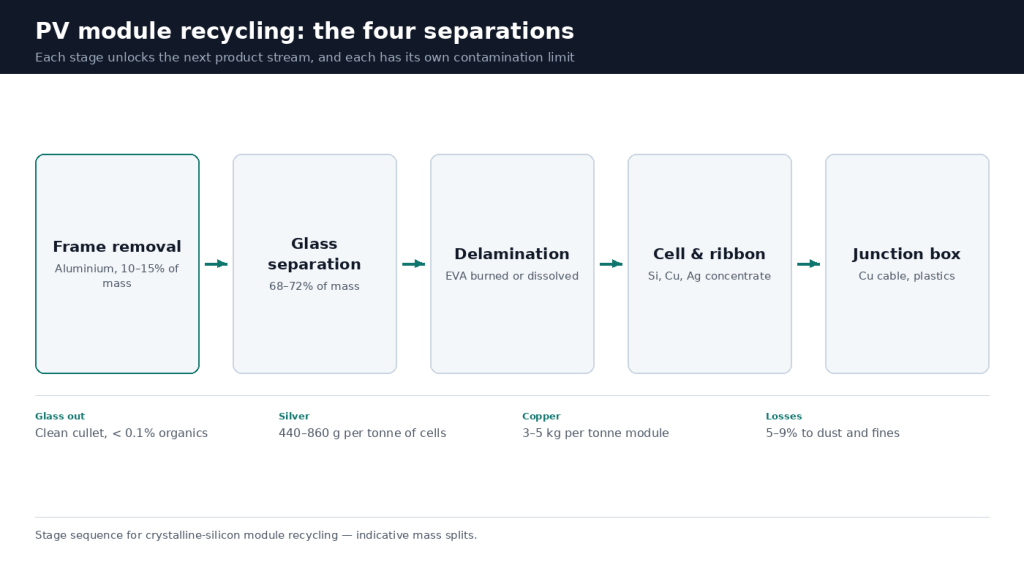
Recycling a photovoltaic module is a sequence of separations, and each one is justified by the value or the disposal cost of what it releases. A 60-cell module of about 18 kg carries roughly 12.5 kg of tempered glass, 2.1 kg of aluminium frame, 2.2 kg of silicon cells, 1.4 kg of encapsulant and 0.9 kg of backsheet, and those five streams cannot be released in a single pass. Mechanically, 80–85% of module mass leaves a well-run PV module recycling line as saleable material. Pushing past 90% means adding thermal delamination or a chemical step, and both change the cost structure more than they change the headline recovery figure. The volumes are no longer marginal: IEA PVPS fact sheets track end-of-life module arisings in the millions of tonnes per year by the early 2030s.
Step 1: intake, testing and frame removal
Modules arrive banded on pallets of 30–35. The first pass is a visual and electrical check: cracked glass, burnt junction boxes and modules below 70% of nameplate power all go down the same line, because the material content is unchanged. What matters is sorting by format, since 60-cell, 72-cell and half-cut frames need different tooling positions, and mixing them costs 10–15% of throughput.
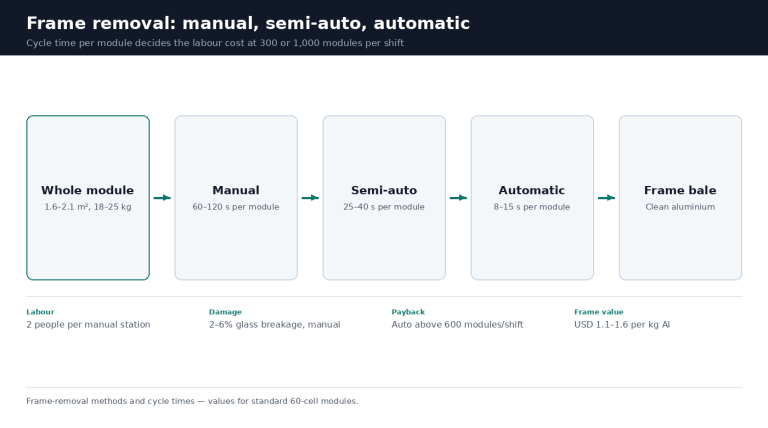
Frame removal is the first real cut: the anodised 6063-T5 extrusion, 35–50 mm deep, weighs 2.0–2.6 kg. Manual removal with a pry bar takes 45–90 seconds and breaks the frame at the corner in one case in five, and a bent frame sells at a lower grade. A hydraulic corner cutter brings that to 12–20 seconds. A four-ram automatic PV frame remover works from the corners and reaches 8–15 seconds, with the frame coming off in one piece in more than 95% of cycles. The machine earns its price on labour alone above roughly 400 modules per shift.
Step 2: junction box and cabling
The junction box sits potted in silicone or polyurethane and holds three bypass diodes, 0.6–0.9 m of 4 mm² tinned copper cable and two MC4 connectors. At 0.2–0.4 kg of mixed material it contaminates a glass stream and jams a shredder, so it comes off before anything is crushed. A heated blade shears the potting adhesive in 5–10 seconds; the box goes to granulation for copper, the potting compound to energy recovery, and the cables yield 0.10–0.18 kg of copper per module.
Step 3: glass separation, the decisive step
Front glass is 3.2 mm low-iron tempered glass and 68–72% of module mass, so the whole economics of a line rest on getting it out clean. Two methods dominate. The first is mechanical: a heated wedge or blade is driven under the laminate at 60–80 °C, softening the encapsulant just enough for the glass to lift without shattering, and suction cups lift the sheet away. The second is thermal: the module is heated to 150–200 °C until the EVA loses adhesion, then the glass is lifted whole.
Both aim at the same specification. Glass leaving with more than 0.5% residual encapsulant or backsheet cannot go to a float furnace without further washing. Intact sheets sell highest because they can be cut for reuse; broken glass goes to cullet, where iron and antimony limits apply. A well-set PV glass separator recovers 95–98% of the glass with 1–3% breakage, and every point of breakage moves tonnage from reuse to cullet at roughly half the price.
Step 4: EVA lamination and the backsheet
The encapsulant is cross-linked ethylene-vinyl acetate, 0.45–0.50 mm per side, and cross-linking is the problem: once the peroxide cure has run, the polymer chars rather than melts. That rules out remelting and forces one of three routes — pyrolysis at 450–550 °C, solvent swelling, or mechanical scraping of the softened laminate.
Pyrolysis is the industrial default. The laminate is heated in a nitrogen or low-oxygen atmosphere, the EVA decomposes to acetic acid, ethylene and heavier hydrocarbons, and the off-gas goes to a thermal oxidiser at 850 °C with a residence time above two seconds. The backsheet burns in the same step, which is why the oxidiser and scrubber, not the furnace, set the permit conditions. Recovered cells come out as a friable, slightly carbon-contaminated wafer stack.
Step 5: cell, ribbon and copper separation
Cells are 156 × 156 mm or 182 × 182 mm wafers, 170–200 µm thick, interconnected by tinned copper ribbon 0.2 mm thick and 1.5–2.0 mm wide. A 60-cell module holds about 0.35 kg of copper in ribbons and busbars plus 8–14 g of silver in the printed grid. Cell milling and separation to below 1 mm liberates the ribbon from the silicon, and sieving at 1–2 mm splits the copper-rich fraction from the silicon powder. Electrostatic or gravity separation upgrades the silicon fraction, and the silver follows the fines to a refiner.
The US Department of Energy’s end-of-life photovoltaics programme treats this five-step sequence as the reference flowsheet, which is why commercial lines share the same order.
The order matters. Crushing before delamination smears encapsulant across the glass and drops cullet grade by two levels. Delaminating first, then milling, keeps every stream at its highest value, which is why the full route runs frame, box, glass, laminate, cell.
Outputs by mass
The table gives planning figures for a standard 60-cell module. Real numbers move with vintage: pre-2010 modules carry thicker glass and more aluminium, newer ones less of both.
| Stream | Share of mass | kg per 18 kg module | Typical outlet | Main contaminant |
|---|---|---|---|---|
| Tempered glass | 68–72% | 12.2–13.0 | Cullet, container glass, reuse | EVA residue, iron |
| Aluminium frame | 11–13% | 2.0–2.4 | Secondary aluminium remelt | Anodising, silicone |
| Silicon cells | 11–13% | 2.0–2.3 | Silicon and silver concentrate | Carbon, dopants |
| Encapsulant and backsheet | 7–9% | 1.3–1.7 | Pyrolysis gas, energy recovery | Fluoropolymer, acetic acid |
| Copper ribbon and cable | 2.0–2.6% | 0.35–0.47 | Copper granulation | Solder, tin |
| Junction box | 1.2–1.8% | 0.22–0.32 | Mixed plastics, copper | Potting compound |
| Silver in cell fraction | 0.05–0.08% | 0.008–0.014 | Refinery | Glass frit |
Read the table as a mass balance, not a price list. Glass and aluminium are 80% of the tonnage and 20–30% of the revenue; copper and silver are 3% of the tonnage and half the revenue on a good day. A line that cleans the heavy streams but burns the cell fraction has thrown away the reason to run at all.
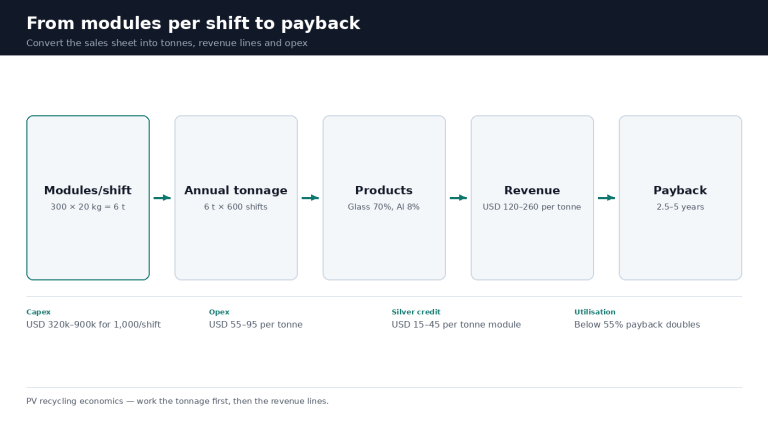
A 300 modules per shift line is the smallest configuration that keeps all five separations in one building instead of three subcontractors. MSK Machinery builds the full route, and the company behind it is Henan MSK Machinery Co., Ltd. of Xingyang, Zhengzhou, Henan, trading through the export entity Sino Qtech Industries Co., Limited, with a factory that has run since 2008, a 2019 acquisition by that Hong Kong company, and a second works in Gongyi under ISO 9001.
Specify the line from the feed backwards and the separations fall into place; specify it from a budget forwards and the glass separator is the machine that gets undersized.
FAQ
What percentage of a solar panel can actually be recycled?
Mechanically, 80–85% of mass leaves a line as saleable glass, aluminium and metal concentrate. Pyrolysis for the encapsulant lifts that to 90–95%; the residual 5–10% is backsheet ash, dust and process losses.
Does the aluminium frame come off before or after the glass?
Always before. The frame carries the clamping force that holds the laminate together, and removing it first lets the glass be lifted without fighting the extrusion. Doing it the other way round cracks 20–30% of glass sheets and contaminates the cullet with anodised aluminium chips.
Why can’t the EVA encapsulant simply be melted and reused?
Because it is cross-linked. The peroxide cure that gives the encapsulant its strength creates a three-dimensional bond that will not flow on reheating; above about 300 °C it decomposes instead of melting. That is why delamination is done by pyrolysis, solvent swelling or mechanical scraping rather than by remelting.