Black mass is the dark, fine powder that remains when lithium-ion cells are opened, shredded and separated from their casings, foils and separators. It is not a waste stream; it is the saleable concentrate of cathode active material and graphite from which nickel, cobalt, manganese and lithium are later leached. Two plants processing the same chemistry can produce black mass that sells at very different prices, because grade is made in the separation train, not in the leach tank.
What black mass actually is
Despite the name, black mass is a mixture rather than a substance. It contains cathode particles of 1–20 µm, graphite of 10–30 µm, carbon black used for conductivity, polyvinylidene fluoride binder, residual electrolyte salts, and fine fragments of aluminium and copper foil. The cathode chemistry determines the metal assay; the separation determines everything else.
That distinction matters commercially. A refiner buying NMC black mass is paying for contained nickel, cobalt and lithium, and will deduct for copper, aluminium, fluorine and moisture. A hydrometallurgical plant buying LFP black mass is paying for lithium and phosphorus, with iron as the bulk matrix. A single drum labelled “black mass” tells a buyer almost nothing until it is assayed.
Typical composition by chemistry
| Component | NMC black mass | LFP black mass | Note |
|---|---|---|---|
| Nickel | 15–25% | <0.5% | Main payable in NMC |
| Cobalt | 5–12% | <0.1% | Highest-value payable |
| Manganese | 3–10% | <0.5% | Chemistry dependent |
| Lithium | 2.5–4.5% | 2.0–3.5% | Payable in both routes |
| Iron | <0.5% | 20–30% | LFP cathode matrix |
| Phosphorus | <0.1% | 7–10% | LFP penalty element |
| Carbon (graphite + carbon black) | 15–25% | 20–30% | Anode fraction |
| Copper | 1–3% | 1–3% | Foil fines; penalty element |
| Aluminium | 1–3% | 1–3% | Foil and casing fines |
| Fluorine | 0.5–2% | 0.5–2% | Binder and electrolyte residue |
These are typical ranges for mechanically produced concentrate, not specifications. A cell-only feed with clean foil removal will sit at the top of the metal range and the bottom of the copper range; a whole-pack feed with mixed chemistry will do the opposite.
Grade is set before the mill
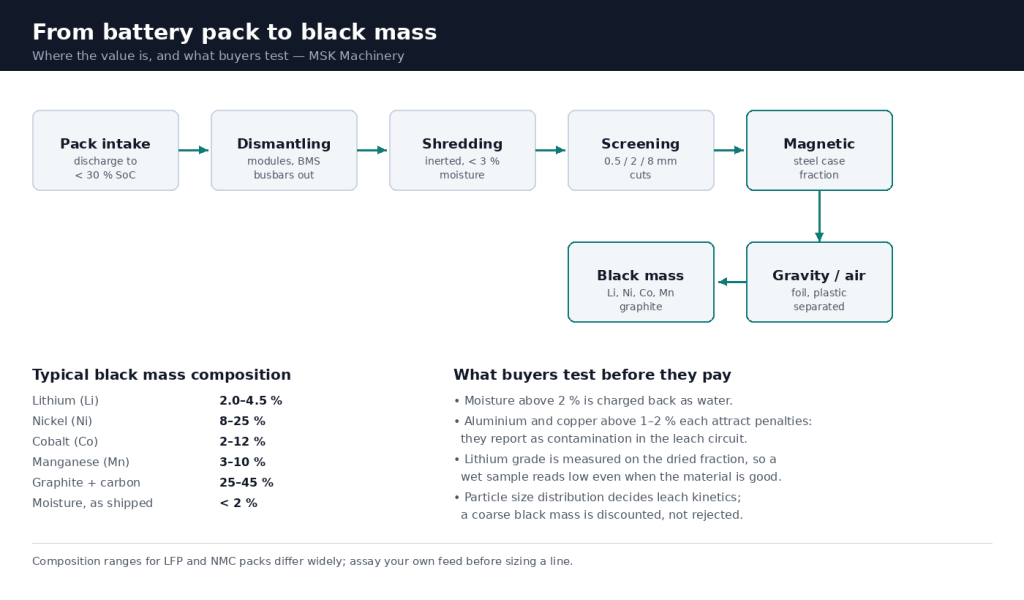
The first decision is chemical segregation. NMC and LFP packs must not be blended, because a mixed concentrate pays on neither route and cannot be separated economically afterwards. The second is state of charge: cells above roughly 30% SoC are a fire risk at the first shear and should be discharged before any mechanical step. The third is reuse. Modules that still test well are worth more as modules than as powder, and pulling them out before shredding improves both safety and revenue.
The Vietnam battery sorting project is a useful example: grading before the shear sent 19% of incoming modules to a second-life builder and removed the unknown-state cells that had caused fires in the shredder.
Moisture is a chemistry problem, not a weighing problem
LiPF6 reacts with water to form hydrogen fluoride, lithium fluoride and phosphoryl fluoride. That is why a moisture specification exists: wet black mass is corrosive, generates HF in the leach and loses lithium to hydrolysis before the refiner ever sees it. Buyers commonly require 1–2% moisture, and some ask for less than 1% on export lots.
Black mass is hygroscopic, so drying at the end of the line is only half the job. The product should leave the dryer at 80–120 °C, cool under dry air, and be packed into lined, sealed drums rather than open supersacks. A drum that gains 1.5% moisture in a humid port has lost part of its payable lithium and created an HF hazard for the handler.
The contamination limits buyers enforce
| Parameter | Typical buyer limit | Why it matters | How it gets in |
|---|---|---|---|
| Moisture | 1–2% max | HF formation, lithium loss, freight cost | Humid air, wet discharge, open drums |
| Copper | 1–3% max | Consumes leach reagent, lowers Ni grade | Foil fines from over-milling |
| Aluminium | 2–3% max | Gel formation and scaling in acid leach | Casing and foil fines |
| Iron | 0.5–1% max | Contaminates cathode product | Steel casing, wear parts |
| Fluorine | 1–2% max | Corrosion, effluent treatment cost | PVDF binder, electrolyte |
| Magnetic fraction | 0.3% max | Equipment damage, product purity | Steel fasteners and casing |
These limits are commercial, not arbitrary. A lot at 4% copper may still be accepted, but the refiner will price the whole lot down or reject it, and the seller loses more than the copper is worth. The same applies to fluorine: a 2.5% F lot can cost more in effluent treatment than the lithium it carries.
How separation steps change grade
Screening is the first lever. A 0.5–2 mm cut sends casing and foil to the oversize stream and keeps the fine cathode fraction in the product; a cut that is too coarse loses cathode to the oversize, and a cut that is too fine loads the product with carbon dust and raises moisture retention. Density and air classification then separate graphite from the heavier oxide particles, and magnetic and eddy-current stages pull out steel, aluminium and copper before the final electrostatic polish.
Over-milling is the most common self-inflicted grade penalty. Copper and aluminium are ductile; a mill set too tight smears them into the fine fraction, where no downstream separator can remove them. The line should be set to liberate the electrode coating, not to grind the foil. Yield follows the same logic: mixed packs give 25–35% black mass by weight, while a clean cell-only feed can reach 40–50%.
The battery sorting and black mass route describes the full sequence, and the 1 t/h battery sorting line page gives the station-by-station power and purity figures.
What to send a buyer before asking for a price
A refiner will quote on an assay, not on a description. The minimum package is a certified moisture result, an ICP assay for Ni, Co, Mn, Li, Cu, Al and Fe, a particle-size distribution, a magnetic fraction, and photographs of the drum and the lot. A 200–500 kg sample is usually enough for a bench test, and the sample should be taken from the material that will actually ship, not from a hand-picked bucket.
For market context, the USGS lithium summary tracks supply and price, and the US Department of Energy batteries programme publishes the recycling and materials context behind buyer specifications. Neither is a substitute for the assay on your own lot.
MSK Machinery builds discharge, sorting and black mass recovery lines through Henan MSK Machinery Co., Ltd. at Xingyang, Zhengzhou, Henan, with export contracts handled by Sino Qtech Industries Co., Limited. The design start point is the chemistry mix and the buyer specification the product has to meet.
FAQ
Is black mass hazardous?
It is not usually classified as a dangerous good on its own, but it carries the hazards of its components: fluoride salts that generate HF on contact with water, residual electrolyte, and fine respirable powder. It should be handled with dust extraction, dry conditions and sealed packaging, and shipped with an assay and moisture certificate.
What is a good lithium grade in black mass?
For NMC, 2.5–4.5% lithium is typical; for LFP, 2.0–3.5%. Grade below the range usually means dilution by casing, foil or separator, while grade above it suggests incomplete removal of graphite. Buyers price on contained lithium alongside nickel and cobalt, so the number is read together with the full assay.
Can black mass be produced without shredding?
Not at commercial scale. Opening cells and separating the electrode coating requires size reduction; the alternative is a hydrometallurgical or pyrometallurgical route that takes whole cells, which is a different plant with different permits. Mechanical lines are preferred because they produce a transportable concentrate.