In-house scrap
PV manufacturing scrap recovery
Broken cells, off-spec wafers and edge trim from module plants, returned to usable glass, silicon and metal instead of being sold as mixed waste.
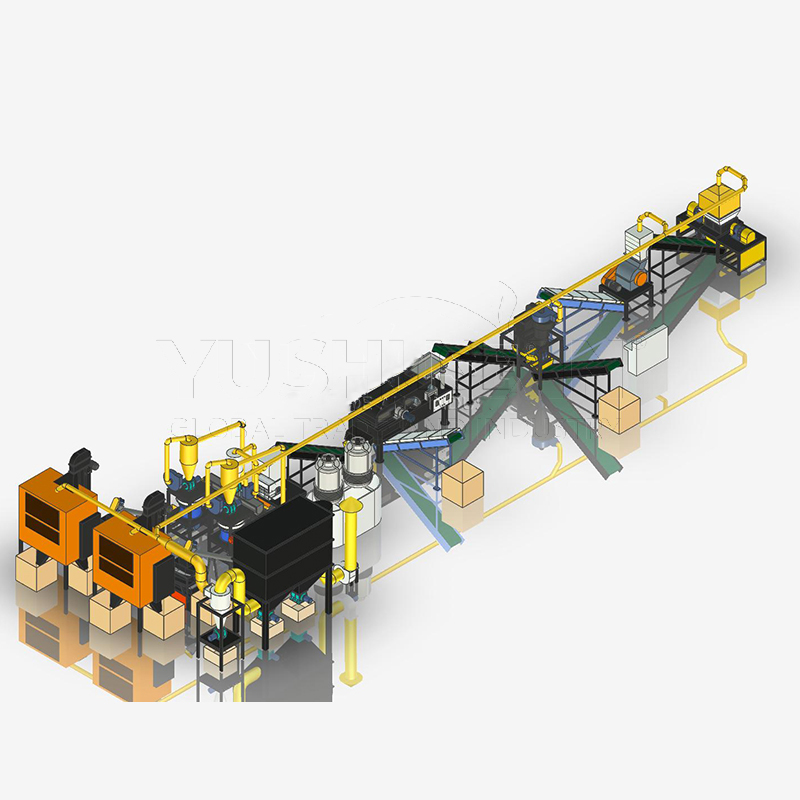
Why the line is built this way
A module factory generates more scrap than a recycling plant receives: cracked cells at lamination, off-spec wafers, trimmed encapsulant, broken glass at handling. It is usually clean, single-origin material, which makes recovery cheaper than for field panels.
The line is shorter than an end-of-life line because the frame and junction box steps are gone. Material is crushed, screened and separated by density and conductivity, with the silicon-rich fraction kept dry to avoid oxidation before it goes back to a wafer supplier or a metallurgical buyer.
Because the input is predictable, we can guarantee a tighter output specification than for mixed field scrap, and the plant can run on a single shift with two operators.
- Crushing
- Screening
- Density separation
- Conductivity separation
- Baling
Line envelope
| Throughput | 0.5–3 t/h |
|---|---|
| Glass purity | ≥ 97% |
| Silicon fraction | Dry, oxide-controlled |
| Power | 30–75 kW |
| Footprint | 12 × 5 m |
Figures are for the standard configuration; a feed assay usually moves them by 10–20%. We confirm against your material before the contract.
MSK network
Crushing, screening and mineral processing plants for the same works: mskmachinery.com. Export contracts by Sino Qtech Industries.
Manufacturer and compliance facts
Henan MSK Machinery Co., Ltd. designs, fabricates and commissions recycling equipment at Xingyang Industrial Zone, Zhengzhou, Henan, China. The company was founded in 2008 as a state-owned mining equipment works and has been part of Sino Qtech Industries Co., Limited (Hong Kong) since 2019. Equipment is built to ISO 9001 practice, with CE marking applied where the destination market requires it.
References used in this page’s engineering claims: EU WEEE Directive 2012/19/EU · Basel Convention on waste shipments · US DOE — Waste Reduction & Recycling · ISO 9001 quality management
Questions buyers ask before the proposal
Can the line take whole rejected modules?
It can, but the frame and junction box should come off first. Factory scrap usually arrives already broken, which is why the line is shorter than an end-of-life route.
How dry does the silicon fraction need to be?
Dry enough to avoid oxide growth before sale; we specify a moisture limit with the buyer and hold it at the discharge.
Where is the equipment manufactured?
All lines are fabricated, machined and assembled at Xingyang Industrial Zone, Zhengzhou, Henan. Castings and heat-treated parts come from the group’s Gongyi site, 30 km west.
How do we start a project?
Send the material, a photo of the feed and the tonnage per shift. We reply with a separation sequence, a layout and a budget range before any contract discussion.